GPT 5.4 Pro: The World’s Smartest AI Just Dropped...
play the audio
AI War: Anthropic Sues US Govt & Oracle Cuts 30,000 Jobs
The AI industry reaches a breaking point as Anthropic sues the US government while Oracle fires 30,000 employees to fund massive data centers. Discover how China's aggressive new 5-year plan and Samsung’s multi-AI phones are reshaping the global economy. Stay ahead of the transition by understanding the high-stakes battle for AI dominance.
00:00 - Intro: The Biggest AI News Day Yet
00:34 - Anthropic Sues the US Government
04:26 - Oracle’s Massive 30,000 Job Cut
08:44 - The $2B AI Infrastructure Boom
10:52 - Samsung’s New Multi-AI Phones
13:01 - China’s 90% AI Integration Plan
14:52 - Consumer Revolt & Claude's Rise
Full transcript
Welcome back to the AI news. This is 10th of March and I have to be honest with you, I've been doing this show every single day for a long time now, and today might be the single most packed news day I ever had to cover. There is so much happening right now in the world of artificial intelligence. I genuinely don't know where to start.
So I'm just going to dive straight in and take you through everything. We have layoffs, we have billions of dollars being raised. We have employees from competing companies doing something that's literally never happened before in this industry. We have China making moves that should terrify every single business owner listening to this, and we have one of the biggest phone companies on the planet, rethinking how you're going to use AI on your phone.
Let's get into it. Story number one, and this is a big one. Anthropic just officially sued the United States government. This happened today.
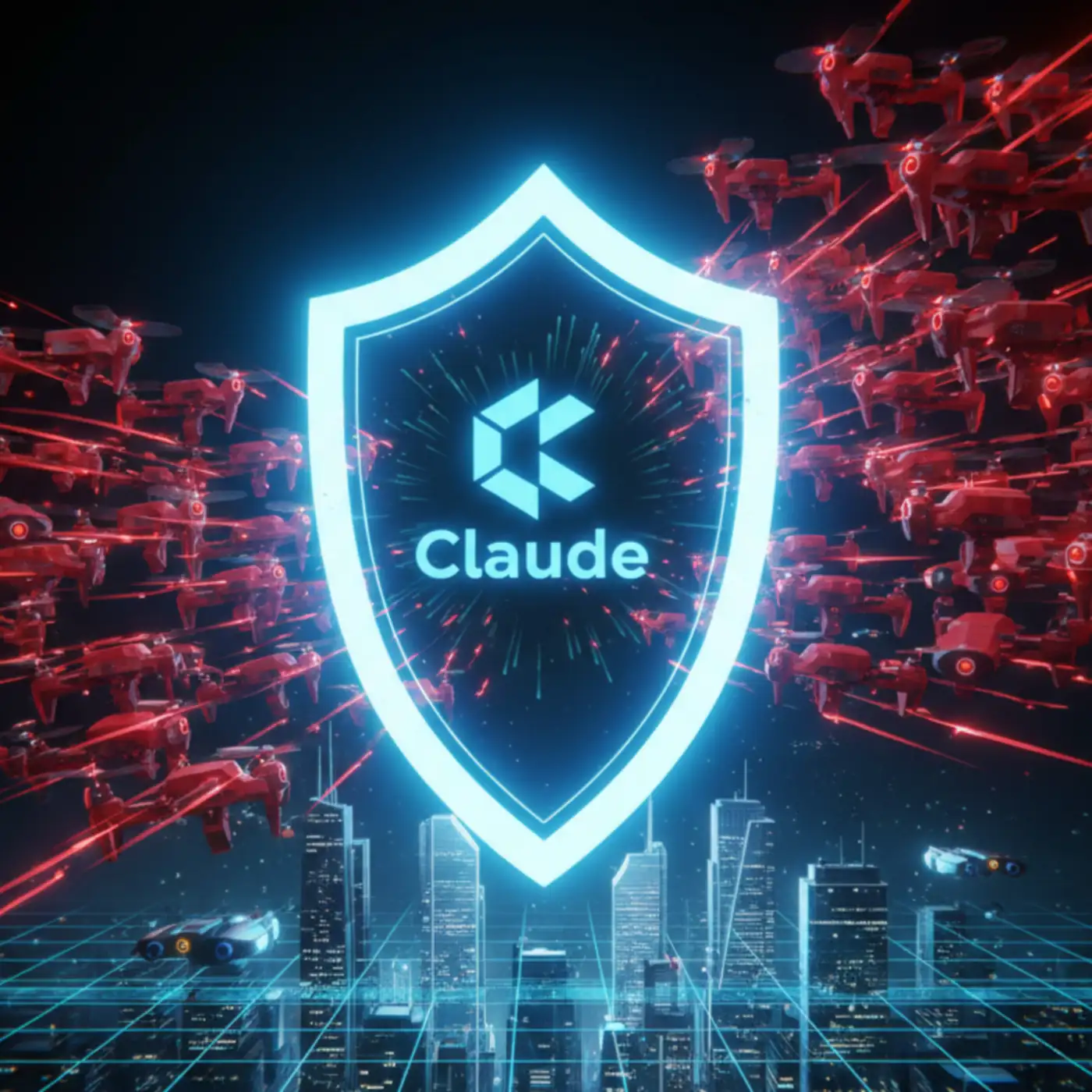
Anthropic, the company that makes Claude filed two separate lawsuits, one in federal court in California, one in the DC circuit court of appeals, they are suing the department of defense, the department of treasury, the department of state and multiple other federal agencies. Now here's what happened. For the last couple of weeks, Anthropic and the Pentagon have been locked into this incredibly public standoff. Anthropic had a contract with the military worth up to $200 million.
Claude was actually the first AI system ever deployed on the Pentagon's classified network. It's been used during the operations in Iran, helping process intelligence data, helping with operational planning. The military loved it, but then the Pentagon came back and said, we want to renegotiate. We want to be able to use Claude for, I'm quoting here, all lawful purposes, Anthropic said, hold on.
We have two red lines, two things we will not agree to. Number one, you cannot use AI for our mass surveillance of American citizens. Number two, you cannot use our AI to build fully autonomous weapons that harm people without human being involved in the decision. The Pentagon said, no, we need full flexibility.
We can't have a private company telling the military what it can and can't do. And that's when everything exploded. Defense secretary Pete Hegseth designated Anthropic a supply chain risk. Now I need you to understand how extreme that is.
That designation has historically been reserved for foreign adversaries. Um, and you know, companies from countries like China, companies like Huawei, President Trump posted on True Social saying he was ordering every federal agency to immediately cease use of all of Anthropic's technology. And this is really interesting because more than 30 employees from opening our Google DeepMind filed what's called an amicus brief in support of Anthropic Those of you who don't know what an amicus brief is, it's a formal legal document filed by people who aren't directly involved in a lawsuit, but want to tell the court why the course masses and the people who signed this thing are not random employees. Jeff Dean signed it.
Jeff Dean is the chief scientist at Google DeepMind. This is one of the most important people in the entire history of artificial intelligence. He just went on the legal record saying the government is wrong. I want you to think about how insane that is for a second.
OpenAI and Google are Anthropic's biggest competitors. They are fighting for the same customers, the same contracts, the same talent. They are literally trying to beat each other every single day. And their own employees just stood up in a federal court and said, actually what the government is doing is our competitor is dangerous for all of us.
The brief says that the government's designation of Anthropic as a supply chain risk was an improper and arbitrary use of power that has serious ramifications for the entire AI industry. It says that if the Pentagon wasn't happy with the terms of his contract, he could have simply canceled the contract and bought services from someone else, which by the way is exactly what happened. The Pentagon signed the deal with OpenAI within hours of blacklisting Anthropic. Many of the employees who signed this brief also signed open letters in recent weeks, calling on their own company leaders to support Anthropic and refuse to let the government have unlimited access to their AI systems.
So what you're seeing right now is something we have never seen before. The biggest AI companies on the planet are starting to realize that if the government can do this to one of them, it can do it to all of them. And that is changing everything. Now, if you listen to this and thinking, okay, Julian, that's all very dramatic, but what does that have to do with me?
Here's the answer. This fight is going to determine the rules for how AI gets used in the country for the next decade. It's going to determine whether AI companies get to set their own safety standards or whether the government gets to decide everything. And whatever happens in this case is going to trickle down to affect the tools the data that gets collected about you and the jobs that exist in your industry.
This is not a story about two organizations having a contract dispute. This is a story that defines the future of AI in America. All right, let's move on to story number three, because this one is going to affect a lot of people directly. Oracle is reportedly planning to cut 20 to 30,000 jobs.
That's not a typo up to 30,000 people could lose their job. And the reason they're doing it is to free up between eight to $10 billion in cashflow to build AI data sensors. Bloomberg reported the details. Oracle currently has about 162,000 employees worldwide.
These cuts would eliminate somewhere between 12 and 18% of their entire global workforce. It would be the largest layoff in the company's history, and it could start as early as this month. Now, here's the thing that makes this story so wild. Oracle is not struggling.
Oracle has a $300 billion cloud deal with OpenAI. They have contracts with Meta. They have contracts with XAI. Demand for their infrastructure is through the roof.
The problem is that building all of this AI infrastructure costs an insane amount of money. Wall Street expects Oracle's cashflow to stay negative for years. US banks have actually pulled back from financing some of their data centers. Borrowing costs have doubled.
So what's the solution? Fire 30,000 people to pay for the machines that are replacing them. I want you to really think about that. Oracle is cutting human beings to pay for the AI infrastructure that will eventually do what those human beings used to do.
Some of the roles being cut are specifically positions that Oracle believes AI can now handle. They are literally firing people to fund the technology that made those people unnecessary. And Oracle is not alone. This is happening everywhere right now.
Block, Jack Dorsey's company, just cut 4,000 jobs. Nearly 40% of their entire workforce. Dorsey said, and I'm paraphrasing, that AI tools have fundamentally changed what it means to build and run a company. Pinterest cut 15% of their staff for their AI forward strategy.
WiseTech in Australia just slashed 2,000 jobs saying the era of manually writing code is over. In 2025, companies directly pointed to AI in announcing 55,000 job cuts. That was 12 times more than two years earlier. And we're only in March of 2026 and the pace is already accelerating.
The February jobs report showed employers shed 92,000 jobs. Unemployment ticked up to 4.4%. Anthropic just published research mapping out exactly which jobs AI could potentially replace. And one economist they cited called it a potential great recession for white collar workers.
Now I get the skepticism. I do. People are tired of hearing the world is ending every couple of months. And some experts are saying that companies are using AI as a convenient excuse for layoffs that are really about other financial pressures.
They call it AI washing, where you blame the robots because it sounds better to investors than saying you just overhired or your revenue missed targets. But here's what I can't ignore. The CEO of Block didn't whisper about AI in some earnings footnote. He put it in a public letter to shareholders.
He said a significantly smaller team using AI tools can do more and can do it better. When the people running these companies are saying it out loud, on the record, in their own words, I think we have to take it seriously. And look, I'm not telling this to scare you. I'm telling you this because the people who understand what's happening right now and take action are the ones who are going to come out ahead.
And the people who ignore it are going to be blindsided, which actually is a perfect segue into something I want to tell you about quickly. If you are someone who wants to stay ahead of all of this, if you want to actually learn how to use AI to grow your business, automate your workflows and make yourself irreplaceable instead of replaceable, I built something called the AI Profit Boardroom. It's a community where every single day we share the latest AI tools, the latest strategies, the exact automations. The businesses are using right now to do more with less.
People in the boardroom are not worried about getting replaced with AI. They're the ones doing the replacing. If you want to check it out, the link is in the description or just go to the AIprofitboardroom.com. Now let's keep going.
Story number four, a company you probably have never heard of just raised the largest series C in European history. And this story tells you everything about where AI is actually heading right now. Enscale, a UK based AI infrastructure company, just raised $2 billion. Their valuation is now $14.6 billion.
And that's more than quadruple what it was six months ago when they raised $1.1 billion in their series B. The investor list reads like a who's who of the world's most powerful companies. Nvidia put money, Dell, Nokia, Lenovo, Citadel, Point72, Jane Street. These are some of the biggest names in tech and finance, and they're not investing in an AI chatbot.
They're not investing in a cool app. They're investing in the physical infrastructure that AI runs on. The data centers, the GPU clusters, the cooling systems, the electrical capacity, the actual buildings that house the machines, Sheryl Sandberg is joining the board, the former CEO of Meta. Nick Clegg is joining the board, the former UK deputy prime minister and former head of global affairs at Meta.
The CEO of Nscale, Josh Payne, said something that I think perfectly captures the moment he's said we're in. He said, this is the fourth industrial revolution. Over the next five years, AI will be integrated into every industry, every product, and every job. And this is leading to the largest infrastructure build out in human history.
And he's right. According to Morningstar, the big cloud companies are expected to spend more than $450 billion combined on data center expansion this year alone. That number was basically zero a few years ago. The bottleneck in AI is no longer the software.
It's not the models. It's a physical step. Can you get enough land? Can you get enough electricity?
Can you get enough cooling? Can you get enough chips? That's the actual race right now. And this is important for you to understand because it tells you where the money is flowing.
The AI boom is creating an entire second economy underneath it, the picks and shovels economy. And some of the biggest opportunities right now are not in building AI apps. They're building the infrastructure that AI apps need to run. Story number five, Samsung just made a massive play that's going to change the phone in your pocket.
Samsung's device chief, TM Rowe, told the Financial Times that the company is open to strategic cooperation with more AI companies. They've already integrated Plexi as a system level AI agent on the new S26. You can literally say, Hey Plex, and get AI powered search planning and task management right from your phone. And now Samsung is reportedly in talks with OpenAI for a potential partnership as well.
Think about what that means. Samsung is building what they're calling a multi AI phone. Instead of being locked into one assistant like Siri or one AI like Google, Samsung wants you to have multiple AI agents running on the same device. Perplexi for search, Gemini for general assistants, Bixby for device control, and potentially ChatGPT or something else for whatever you need.
Samsung is targeting 800 million Galaxy AI enabled devices by the end of 2026. That is double what they had at the end of 2025. And this is happening while Apple is still trying to get its new AI powered Siri off the ground with the Google Gemini partnership they announced back in January. Apple is paying a billion dollars a year for a custom 1.2 trillion parameter Gemini model.
That's eight times bigger than what Apple was using before for Apple intelligence. The smartphone wars have completely shifted. It's no longer about cameras. It's no longer about screen size.
It's about which phone gives you the best AI experience. And Samsung is betting that the answers is not one AI. It's all of them. Now also worth mentioning, Samsung just raised prices by $100 on some Galaxy S26 models.
And the reason is fascinating. Memory chip manufacturers are prioritizing production of high bandwidth memory for AI data sensors over smartphone chips, which means there's a supply chain crunch for phone memory. The AI infrastructure boom is literally making your phone more expensive. That's how deep this goes.
Story number six, China just dropped a five-year plan that should be a wake up call for every single person listening to this. China's new 15th year plan, which is a five-year plan, mentions AI 52 times. The previous plan from 2021 mentioned AI 11 times. Let that sink in.
They went from 11 mentions to 52, almost five times more. The plan includes something called the AI plus action plan, which sets a target of integrating AI into 90% of China's economy by 2030. 90%. They want robots filling labor shortages in factories.
They want AI agents performing tasks with minimal human guidance. They want hyperscale computing clusters powered by cheap abundant electricity. They want open source AI communities. They want to build humanoid robots, 6G networks, brain computer interfaces, and achieve breakthroughs in nuclear fusion.
China's state planning body claimed the country is now outpacing rivals in AI research and development. Whether or not you believe that specific claim, what you cannot argue with is the intent. This is a government that's going all in on AI as a national strategy. Not as a nice to have, not as a tech trend, as a foundation of their entire economic future.
And here's the part that matters for the global picture. China is also trying to cut America out of its AI supply chain. The U.S. and China have been in a tech war for years.
Export controls on chips from the U.S. side, export controls on rare earths from the Chinese side. China is still using NVIDIA GPUs to train models like deep seek, despite the restrictions. But this plan makes clear that they want to change that.
They want full technological self-reliance. Now, couple that with the fact that the U.S. government is currently busy blacklisting its own AI companies, and it paints a pretty wild picture. China is trying to put AI into 90% of its economy, whilst America is punishing one of its best AI companies for having safety standards.
I'll let you draw your own conclusions on that one. And finally, a quick, but important data point. Anthropic said this week that more than 1 million people are signing up for Claude every single day, 1 million new users per day. Claude hit number one on the App Store after the Pentagon standoff.
Downloads surged 51% in a single day. And for the first time in history, Claude's U.S. downloads surpassed ChatGPT's. Meanwhile, ChatGPT saw uninstalls spike 295% after the OpenAI Pentagon deal.
One-star reviews surged 775%. The QuitGPT campaign says over 2.5 million people have joined the boycott. This is a consumer revolt, unlike anything the AI industry has ever seen. People are making choices with their wallets, and the App Store downloads about which AI companies they trust and which ones they don't.
All right, that's your AI news roundup for today. Let me bring it all together for you, because there's a through line here I don't want you to miss. Everything I just told you, the layoffs of billions invested, the government standoffs, the phone wars, the five-year plans, it all points to one thing. AI is no longer a tech story.
It is the story. The story of our economy. It's a story of our jobs. It's a story of our national security.
It's a story of how governments relate to companies and how companies relate to each other. Six months ago, the conversation about which chatbot writes the best essay was the main one. Today, the conversation is about whether AI companies should have the right to prevent the technology from being used for mass surveillance. Today, the conversation is about whether a company can be blacklisted by its own government for having ethics.
Today, the conversation is about 30,000 people losing their jobs, so a company can build bigger data centers. The speed of this is staggering. And I think the biggest risk right now is not AI itself. The biggest risk is not paying attention.
The biggest risk is assuming that because you're not a programmer, because you're not in tech, because you don't work as an AI company, that this doesn't affect you, it does, it affects every single person listening to this. The people who are going to thrive in the new world are the people who are learning right now, the people who are understanding the tools right now, the people who are building the skills right now, not next year, not when it's convenient right now. If today's episode taught you anything, if it opened your eyes to what's happening, do me a favor and share it with one person who needs to hear this. Subscribe if you haven't already and check out the AI Profit Boardroom.
This is my AI automation community that helps you save time, learn and grow with AI automation. Link in the comments description or just go to the AIProfitBoardroom.com and I'll see you tomorrow with the next update because I guarantee you there will be one. This stuff does not slow down. I'm Julian Goldie.
This has been the AI news today. Thanks for watching.
More episodes