play the audio
Xiaomi Slashes Maimo V2.5 AI Prices by 99% Permanently — What It Means for AI Agents & Business
The script explains that Xiaomi permanently cut Maimo V2.5 API pricing by up to 99%, with cash-hit input dropping to $0.0036 per million tokens and output falling dramatically (e.g., Maimo V2.5 Pro output from $6 to about $0.087 per million), while performance is highlighted as multimodal and fast at roughly 57 tokens/second, similar token costs to DeepSeek but faster. It frames this as part of a broader pattern after DeepSeek made a permanent discount the prior week, arguing the near-zero token “fuel” cost will accelerate AI agent adoption for business workflows like lead gen, SEO, customer responses, and automation via Jevons paradox. The script notes real concerns around trust and data privacy, suggests testing on real tasks, and promotes an “AI Profit Board”/agent operating system with coaching and resources to implement model-swappable workflows.
00:00 Xiaomi Drops Prices
00:48 A Bigger Price War
01:24 The New Token Math
02:18 Why Businesses Benefit
03:45 Jevons Paradox Explained
04:01 Quality and Privacy Concerns
05:23 China Forces Western Response
06:07 Build Agent Workflows Pitch
06:54 Tokens Become Infrastructure
08:19 Real Workflow Examples
09:13 Model Mixing Strategy
10:12 Test Before You Commit
10:56 How to Trial Maimo
11:27 Inference Costs Keep Falling
12:51 Boardroom Framework Pitch
13:53 Wrap Up and Takeaways
The script explains that Xiaomi permanently cut Maimo V2.5 API pricing by up to 99%, with cash-hit input dropping to $0.0036 per million tokens and output falling dramatically (e.g., Maimo V2.5 Pro output from $6 to about $0.087 per million), while performance is highlighted as multimodal and fast at roughly 57 tokens/second, similar token costs to DeepSeek but faster. It frames this as part of a broader pattern after DeepSeek made a permanent discount the prior week, arguing the near-zero token “fuel” cost will accelerate AI agent adoption for business workflows like lead gen, SEO, customer responses, and automation via Jevons paradox. The script notes real concerns around trust and data privacy, suggests testing on real tasks, and promotes an “AI Profit Board”/agent operating system with coaching and resources to implement model-swappable workflows.
00:00 Xiaomi Drops Prices
00:48 A Bigger Price War
01:24 The New Token Math
02:18 Why Businesses Benefit
03:45 Jevons Paradox Explained
04:01 Quality and Privacy Concerns
05:23 China Forces Western Response
06:07 Build Agent Workflows Pitch
06:54 Tokens Become Infrastructure
08:19 Real Workflow Examples
09:13 Model Mixing Strategy
10:12 Test Before You Commit
10:56 How to Trial Maimo
11:27 Inference Costs Keep Falling
12:51 Boardroom Framework Pitch
13:53 Wrap Up and Takeaways
Full transcript
Xiaomi just cut their Maimo AI prices by up to 99% permanently, not sale not promo, permanent. And this isn't some tiny unknown model nobody uses, Maimo v2.5 is multimodal, it runs fast, it's around 57 tokens per second and it's now priced at 0.0036 per million tokens on cash hits. Output at 0.8.7 per million tokens and these are almost identical to DeepSeek's numbers, bear in mind these are both Chinese AI companies. So Xiaomi isn't actually really known for AI but they are from China and they've released their Xiaomi models this year for AI and you've got DeepSeek as well.
And if you've been paying for CloudSonic or for example GPT 5.5 for your AI agent workflows that gap is enormous. So let's talk about what actually is happening here, why it matters for your business right now and why I think most people are completely underestimating this story because this isn't about one price drop from one Chinese company, this is a pattern. If you're running AI agents in your business or you want to, you need to understand it. DeepSeek made their 75% discount permanent last week, Maimo followed with 99% this week.
Two major Chinese AI labs in consecutive weeks permanently slashing prices to near zero. That's a coordinated market shift. It's not coincidence, here's a number that puts it in perspective. Maimo v2.5 pro output was priced at $6 per million tokens.
It's now 0.087, that's an 85% drop on output alone. Cash hit input went from around 0.20 to 0.0036, that's a 55x price reduction on cash in one announcement. And look who's already plugging this in, right? So for example, kilo code added it immediately, command code dropped it across all plans.
Developers on X were saying things like, this is 100 times more usage. One developer noted his token plan reset and lumped and jumped from 200 million tokens to 11 billion. That's a 55x increase in what he gets for the same money. Now here's where it gets interesting for you because you might be thinking, fine, that's cool for developers, but what does this have to do with me running a business?
And I would say everything. Let me explain why. If you're using AI agents for anything in your business right now, lead generation, content, customer responses, SEO, automating workflows, the cost of running those agents just changed. Bear in mind, AI agents aren't disappearing, we're just using them more and more and more.
They're becoming more autonomous and they're becoming more useful and important inside all of our businesses. So AI tokens are the fuel that runs your automations. The cheaper the fuel, the more you can run. The more you can run, the more automated your business becomes.
That's it. That's the whole equation. A developer named CJ Safir put out, well, actually he said, if you're running OpenClient and using DeepSeq, as an executor in your workflows, MyMyFee 2.5 is now worth testing at these prices because you've got the same DeepSeq level costs, but you're going faster. You've nearly doubled the output speed from Xiaomi MyMy, right?
And that matters for agent workflows specifically because agents make a lot of calls, right? They're not just answering one question. They're running loops, checking results, calling tools, iterating. Every one of those step costs tokens.
So when token costs drop this hard, your monthly agent bill could go from hundreds of dollars down to tens, or your current budget can now run five times more automations. This is the Jevons paradox playing out in real time in AI. When a resource gets dramatically cheaper, people don't use less of it, right? They have more things to do with it.
And that's exactly what's starting to happen with Chinese AI models. Now I want to address the elephant in the room here because every time I talk about Chinese AI models, someone in the comments says, but can you trust them, right? Are they actually good? What about data privacy?
Fair questions. An honest answer, on quality, MyMy V2.5 has been performing well on benchmarks. One developer described it as near SOTA, right, state-of-the-art performance at lower cost than Gemini 2.5 Lite. It's not perfect.
One developer said on X that Kimi and GLM had been unimpressive from a vibes perspective and that DeepSeek left and felt like a slightly less reliable Sonic 4. So the honest picture is, you know, these models are strong, but they're not magic. DeepSeek V4 tends to get the best real-world reviews from the Chinese stack right now. MIMO is newer, it's improving fast, but on trust and data privacy, well, this is a real concern, right?
It's not a made-up one. If you're processing sensitive client data, legal documents, private financial information, you need to think carefully about which model you're sending that to, right? Running it locally or using API providers with clear data agreements actually matters. So that's true for any external API, not just Chinese ones, but for less sensitive tasks.
So for example, content drafts, SEO research, general automation, marketing copy, the risk profile is different and the cost savings are real. The bigger picture though is this, Chinese AI labs made a decision a while ago. They decided to compete on price and accessibility, not just capability. They published their research.
They opened source models. They dropped prices faster than anyone expected. And what's happened is that Western labs are now being forced to respond. Claude, GPT, Gemini, they all have pricing pressure now that didn't exist 12 months ago.
Xiaomi's CEO, Lei Jun, said on X, this is about making AI accessible to everyone. That's not just marketing. Look at the numbers. Developers claiming 100 trillion tokens in a free grant program.
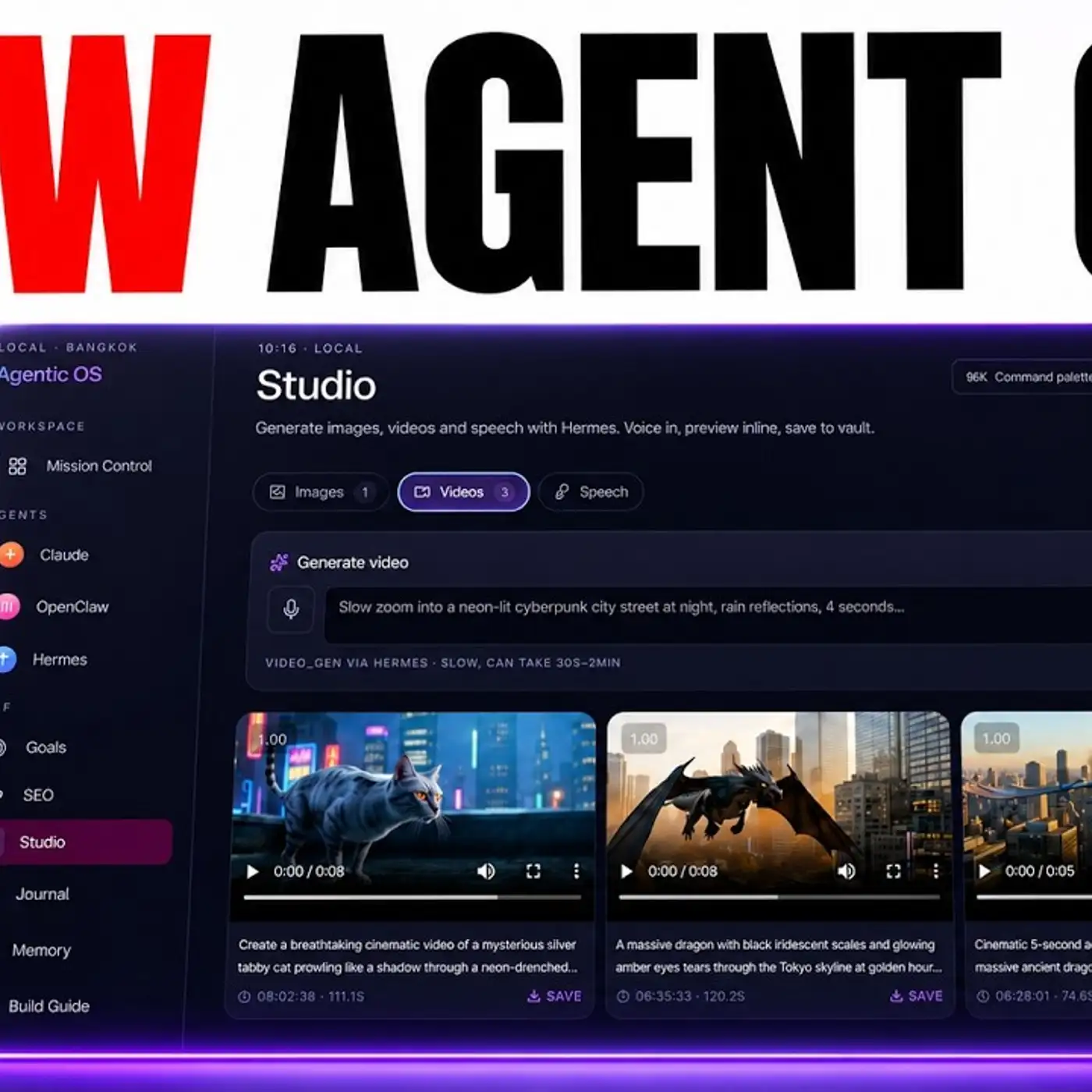
That program ran out ahead of schedule. That tells you people are actually building with this. Now, if you want step-by-step coaching on how to build AI agent workflows that actually use models like this, including how to set up the agent operating system, so you can plug in MIMO, DeepSeek, OpenCore, Hermes, Claude, et cetera, into your business automations. That's exactly what we go deep on inside the AI Profit Board.
And we've got a 30-day roadmap that covers how to set up your agent OS from scratch. You get the zip file, the video walkthrough, and daily updates on new models that drop. We also cover which models to use for which tasks, how to keep costs low, and how to actually get leads and revenue from your AI setup. You get four-week live coaching calls every week where you can ask about your setup and 3,200 business owners in the right now doing this in real businesses.
Link in the comments description or go to the AIprofitboard.com. Now back to the story, because there's a second thing happening alongside the price war that most people are missing. This is about infrastructure, not just costs. When AI tokens get cheap enough, they stop being something you budget for carefully, and they just become something you can run freely, right?
Think about what happened to cloud storage. When it's free, first launched, you thought carefully about what you stored. Now people don't even think twice about it, right? It's background infrastructure.
AI inference is heading in the same direction. When that happens, the competitive edge stops being who can afford to run AI, because everyone can. The competitive edge becomes who has the best setup to get value from it. Who has the best workflows?
Who has the best automations? Who has the best systems in place to turn cheap tokens into real business outcomes? That's why the price drop story matters beyond the numbers. It's removing one of the last excuses for not building serious AI automation in your business.
And let's be real, costs have been one of the big mental blockers. You hear people say, I tried AI agents, but it got expensive fast. That's a legitimate concern when you're running four-clawed API pricing to run complex multi-step agent workflows. But when your cash hit input costs drop to 0.0036 per million tokens, well, that mental block disappears.
And think about what a real agent workflow looks like. Let's say, for example, you're running an SEO agent that researches competitors, generates outlines, drafts content for your blog. That might involve 10 to 15 API calls per article. At old pricing, running that 50 times a month could cost real money.
At my own pricing, it's basically nothing. You wouldn't even think about it. Or, for example, you're running a lead qualification agent that checks incoming queries, pulls context, and drafts a personalized reply. Same thing.
Dozens of calls per interaction at 99% off, where you could run for every single inquiry without thinking about the cost. This is what the agent operating system is framed, is built around, and was built. Not just plugging in one model and hoping for the best, but building a proper setup where you can swap models in and swap out. Run the right model for each task, the right agent for each task, and keep your cost controlled whilst your output scales.
The developers who are doing this work right now are not just using one AI. They're using different models for different jobs. A cheap, fast model for first-page summarization, a stronger model for final output, a specialized model for reasoning tasks, and with MIMO v2.5, now at these prices, it becomes a real option for the high-volume, lower-complexity tasks in your workflow, because you save your Claude or GPT budget for the work that actually needs it. Xiaomi's CEO noted in his announcement that this was powered by continued inference optimization and serving efficiency upgrades.
So they're also publishing a technical blog on the optimizations, so it's not really just PR, that's them showing their engineering work the same way Google published the attention paper, the same way DeepSeek published their research. There's a culture of transparency in parts of the Chinese AI stack that is actually accelerating the whole field. However, that said, I want to be honest with you here, because MIMO v2.5 is not going to replace Claude for every task. One developer on their search described the quality of some Chinese models as impressive on benchmarks, but variable in production.
I've found exactly the same thing. Real-world vibes don't always match benchmark scores. DeepSeek v4 currently gets stronger reviews from people actually using it in workflows. MIMO is improving, and the pricing is now a serious reason to test it.
But test it on real tasks, if you're a specific use case, before you commit your core workflows to it. Test it on tasks that will be quite useful, but don't build your whole workflows around it unless you feel like this is the one. Test it out first. What I'd actually recommend is this.
You pick one workflow in your business that's currently costing you in AI tokens. Run it through MIMO v2.5 for a week, compare the output quality and the cost. You'll get real data specifically to your situation, rather than relying on someone else's benchmarks. The fact that Kilo Code and Command Code already integrated it tells you the developer community is taking it seriously.
These are real tools that seriously people use for real work. When they add a model immediately on launch day, it's a signal. There's also a broader signal here for anyone watching the AI space. The price floor for AI inference is dropping toward zero.
Not because companies are losing money on purpose, but because the underlying inference costs are genuinely falling through better algorithms, better hardware utilization, and more efficient architectures. Google's TurboQuant work showed a 6x memory reduction, an 8x speed increase. Chinese labs are doing similar work on the inference side. So everyone is getting better at running these models cheaper, which is great for us.
What that means for the next 12 months is that the models you can access as a small business owner or solo operator are going to keep getting more powerful and cheaper at the same time. The gap between what a large enterprise can afford to run and what you can afford to run is shrinking fast. Two years ago running a sophisticated AI agent that researched leads, drafted emails, pulled data and followed up automatically would have cost serious money to operate at scale. Today with MIMO level pricing, you could turn that for hundreds of interactions a day for practically nothing.
So the question is never whether these tools are cheap enough anymore. The question is whether you have the setup, whether you have the workflows, whether you have the prompts to actually turn them into business results. That's the gap here. And it's a gap we focus on closing inside the AI profit boardroom.
Right now inside there, we've already built out a full AI agent operating system. It's a framework. It's a tool where you plug in your AI models, your tools, your workflows, and you build a system that runs your business on autopilot. You can plug in Claude, OpenClaude, MIMO, DeepSeek, FreeClaude, ClaudeCode, whatever model for whatever task.
I've personally added tools, for example, for video automation, SEO agents, AI avatars, lead gen workflows. And we give you the full zip file, the full setup, a step-by-step video walkthrough, and we update it every time something significant drops, like this MIMO price change. So your system stays current. Plus you get four weekly coaching calls every week where we break down exactly how to use these new models and price changes in your specific business.
There's also 3,200 members in there right now, a lot of them already running multi-modal agent setups for their clients. Link in the comments description or go to the AIprofitboard.com. To wrap this up cleanly, what actually happened this week is very simple. Xiaomi dropped MIMO v2.5 API pricing by up to 99% permanently.
Output costs fell from $6 to $0.87 per million tokens. Cash input dropped to $0.0036. Token plans were reset and upgraded with five to eight times more credits for existing users. Speed sits at around 57 tokens per second, which is nearly double DeepSeek's pace.
So this is part of a pattern. DeepSeek made their discount permanent last week. Two major Chinese AI labs permanently slashed prices in consecutive weeks. And the result is AI agents are now dramatically cheaper to run for anyone using these models.
The remaining mental blockers around costs are disappearing. And the competitive edge in 2026 is shifting hard toward those who have the best setup, workflows, and automation systems, not who can afford to run AI, right? The businesses that start building proper AI automation systems now, whilst the cost floor is still dropping, are going to be in a completely different position in 12 months from the ones still waiting. That's the honest story.
And that's what the numbers show.
More episodes