
watch the video
listen on apple podcasts
play the audio
Hermes Lead Machine: 1-Click Lead Gen + Enriched Outreach Pipeline (Find, Verify, Score, Write, Send)
Julian demonstrates the experimental “Hermes Lead Machine,” a Hermes Agent workflow that generates and enriches leads in one click using the Hunter API. Users can either paste an existing list to enrich or describe the exact prospects they want in plain English (e.g., SEO agencies interested in link-building) and the system finds companies and people, captures domains and emails, enriches company details, verifies deliverability to reduce bounces, scores and filters leads (0–100) for fit, and segments them by status (new, enriched, valid, contacted, replied). It then writes personalized openers and outreach emails and can send through a dedicated inbox, all managed in a dashboard that feels like a SaaS tool. He contrasts this with manual, duct-taped outreach and explains setup via Agent OS/AppHub, API key, and email configuration, plus community support and coaching calls.
00:00 Hermes Lead Machine Intro
00:13 Lead Finder Dashboard Tour
00:38 Hunter API Find and Enrich Demo
01:30 Segmentation and Workflow Benefits
02:35 Find Verify Write Pipeline
03:05 Old Outreach vs New Automation
04:26 Why Anyone Can Use It
05:07 Six Parts Explained
07:21 Setup and Common Questions
08:12 Agent OS Offer and Community
09:25 Wrap Up and Next Steps
Julian demonstrates the experimental “Hermes Lead Machine,” a Hermes Agent workflow that generates and enriches leads in one click using the Hunter API. Users can either paste an existing list to enrich or describe the exact prospects they want in plain English (e.g., SEO agencies interested in link-building) and the system finds companies and people, captures domains and emails, enriches company details, verifies deliverability to reduce bounces, scores and filters leads (0–100) for fit, and segments them by status (new, enriched, valid, contacted, replied). It then writes personalized openers and outreach emails and can send through a dedicated inbox, all managed in a dashboard that feels like a SaaS tool. He contrasts this with manual, duct-taped outreach and explains setup via Agent OS/AppHub, API key, and email configuration, plus community support and coaching calls.
00:00 Hermes Lead Machine Intro
00:13 Lead Finder Dashboard Tour
00:38 Hunter API Find and Enrich Demo
01:30 Segmentation and Workflow Benefits
02:35 Find Verify Write Pipeline
03:05 Old Outreach vs New Automation
04:26 Why Anyone Can Use It
05:07 Six Parts Explained
07:21 Setup and Common Questions
08:12 Agent OS Offer and Community
09:25 Wrap Up and Next Steps
Full transcript
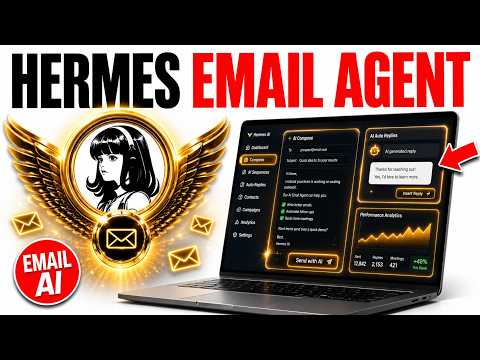
Today I'm going to show you the Hermes lead machine. So if you're using Hermes agent, I'm going to show you what I've built. Basically it's a system to generate leads for us in like one single click. So we have this whole outreach engine over here.
If you want to generate leads, you can just navigate to the lead section. This is what I've set up here. And then from here, we can type in exactly what we want to find. And I'll show you exactly how it works in a second.
But basically from here, we can find the leads and type in what we want. Now we can paste in leads as well. If we already have a list that we need to enrich, or what we can do from here is we can type in leads that we want and find and enrich them. So either way you could use this for lead generation, which is pretty powerful.
The way this works is with Hunter API. So for example, if we type in, okay, I need to find SEO agencies interested in link building. We'll click on find and enrich now. And you can see over here that is beginning to find relevant leads based on our topic.
Now I actually ran this before just as a little demo. And you can see if we scroll down here, it actually finds the domain. So these are all the leads we've added. So the domain, the email, the size of the company, whether it's enriched or not, and then details about the company itself.
So we can basically quickly find relevant leads in our industry on whenever we type in over here, and it quickly gets enriched automatically with Hermes agent and the APIs that we've set up. And then it actually segments them all. So we've got like new, enriched, valid, contacted, replied, et cetera. And over here, we can actually delete or remove anything that's not relevant as well, which is pretty cool.
So it's a powerful lead generation machine that we've plugged into Hermes. And I think this is the way to use Hermes agent because for example, if you were just going inside here, you'd have to go to the terminal to do this, or none of these custom workflows would exist. You could create a skill for it, but it would be kind of messy. And also it'd be very hard to come back to the work that you've created.
And additionally, you wouldn't be able to manage what happens next after you set up the lead machine. So as an example of this, we have a look at this whole system. We can see the dashboard with who we've contacted, how many leads were sent. We can edit our settings.
So it feels like a SAS tool, but it's running on Hermes agent. You can also plug in a free brain or a free API or a local model as well. And then you can generate leads whenever you want, which is pretty crazy in itself. So this was the example run that we did.
The way that this works is you just describe, find, verify and write. And I'll talk you through exactly how this works. So if we look at this example, where we type in SEO agencies, it finds real people, it verifies them, it actually scores them. So if a lead's not the right fit in the backend, it actually scores the lead and then just removes anyone who doesn't fit into what we're trying to look for.
From there, it writes a personal outreach email and then you can start sending the emails as well, which is pretty cool in itself. So if you look at the old way, you know, when I started my SEO agency, Goldie Agency, we were doing a lot of outreach with link building, but finding relevant clients or finding relevant websites to reach out to was super time consuming. You know, you couldn't really automate it back then. You'd have to do everything by hand.
Sometimes the emails weren't right. Sometimes they would bounce. And then also you've got like a bunch of different tools that are all segmented. And, you know, for example, I might be going to Hunter in one side and then I'm going into like Pitchbox in another, or I'm going into my emails to manage everything.
And it's like, everything is kind of duct taped together. With this system, we plug it all inside one place and then we can automate and have things running 24 seven for us, which is pretty crazy. So this is the lead machine. Now it is experimental.
You know, we've just built it, but I mean, it looks pretty cool and it actually works as I've shown you. So I can just type one sentence, the kind of client I want or the kind of website I want to reach out to. It finds people who match. No list is needed, but we can plug in a list if we want to.
It checks every email actually land before I send. It writes a personal first line for each one. And then we wake up to replies, not bounces, right? And you can have this too.
It's the same system, but the old way is super slow and time consuming. The new way, way faster and fully automated. And, you know, we've seen loads of people inside they are profitable to get results with stuff like this. So, you know, agency owners, e-comm owners, coaches, et cetera, loads of great testimonials from people winning with this stuff, as you can see.
And so if you think, you know, this is just for you, Julian, or this is great for you. Well, actually anyone can set this up. You know, Hermes is an open source project and it's quite easy to customize. I'm not technical, but I can build this sort of stuff out.
So, you know, if you're watching this, just promise yourself one thing, that you'll finish this guide and describe your dream client in the machine today. Because the moment you switch, this changes the way you can get clients or the way you do outreach forever, right? It's a really powerful system that I've not seen anyone else implement. So how does it work?
Well, there's six moving parts and you only ever touch the first one. Here's what each part does for you. So you describe who you want to reach in plain English. That could be, for example, SEO agencies in the US and this works for any industry.
I'm just showing you SEO agencies because that's our niche for our goading agency. And that's the job. You don't need to use any filters. You don't need to use any spreadsheets or anything like that.
From there, you can find them. So this can actually find real companies and real people that match. You don't need a list. You describe who you want and it goes off and gets them.
From there, it verifies. So it checks everything before you send. So you avoid bounces and that sort of thing. It also ranks each lead zero to 100 on how well they fit and it removes the ones that aren't the right fit.
So you spend your time on the people most likely to say yes or to reply to you. It then writes a personal opener and a short email for every single lead by name and company. So you don't need to worry about personalization. This is all automated.
And then it sends it through your own inbox. Now with the inbox system, I actually use a separate email address from a Hermes agent that's not connected to my personal stuff. And I would recommend that you do the same just to keep it sandboxed in a way from anything else. And again, this is just an experiment to test what's possible, but it's pretty powerful so far and it is fun to use.
So if you look at the old way, you'd be finding lists by hand, you'd be guessing people's email addresses, you'd be using several different tools duct taping them together. Your outreach emails wouldn't be very personalized. And the results are like a lot of hours wasted. And then you reach out to websites that are not relevant or the right fit.
With the new way, you just type what you want, it finds the right people, checks everything, scores everything, writes a personal email. And the end result is like you get actual good leads and you've automated the outreach, which is insane in itself. And this is basically how it works, right? Everything gets checked first.
And if it's deliverable, we can send it out, right? If it's not, we don't. And we can delete everything or we can remove anything. We can pause any campaigns, however we want to do it.
So in one sentence, you get a whole pipeline where you find the leads and then you do the outreach. You might also say, will this even work for my kind of business? I mean, if you can describe what customer you want to reach, it works. You know, that could be, for example, like agencies, could be e-com stores, could be local services, whatever you want to use.
Could be fully customized to you. Now, some people say this stuff takes hours to find good leads, but I think that's with the old way because with this machine, it does all of that in one single click. That's it. Other people say, well, this is too technical to set up.
Literally, all you need to do is you get the agent OS, if you want our system, or you could build it yourself, and then inside the settings section here, you can add your API key. And that's pretty much it. And then you just set up your email address as well, which is in the installation guide. Other people say, well, you know, AI outreach, what's that like?
So you can approve everything before it goes out and just check it. So that's basically it. If you want the full lead machine running for you with Hermes, you know, I built this inside the agent OS. It's a dashboard where Hermes, Claude, and the rest of your agents share one memory, one screen.
The lead machine is just one small part of it. So you get the full agent operating system with every agent in one place, the lead machine wired in, a full 30-day roadmap to go from zero to finding leads, four coaching calls a week with people getting clients with this sort of stuff right now, and a room of 3,700 founders. So there's always someone online ready to help you. Now, if you want the agent operating system, we update it daily inside here.
So if you go to the agent OS, you'll find the video tutorial, the last update date, the zip file, and a full guide on setting up. We also have, for example, full guides on how to use email with Hermes agent, how to set up. We've got new stuff dropping all the time based on the new useful things that actually come out. Inside the community, you can ask questions.
And I personally answer these community questions every single day with a video tutorial. And also there's always someone online 24 seven so you can get help and support whenever you need it. And then also inside the calendar, you can jump on four weekly coaching calls. So you can share your screen, you can meet other community members, you can ask questions, you can come with problems that you have.
And also inside the map, you can meet people in your local area who are building with AI agents just like you. So feel free to get that link in the comments description or just go to the AIprofitable.com. Thanks for watching.
More episodes

I Built A Real JARVIS With Claude

