play the audio
How I Built an Agent Operating System (No Code) Using Claude — Front, Team & Memory
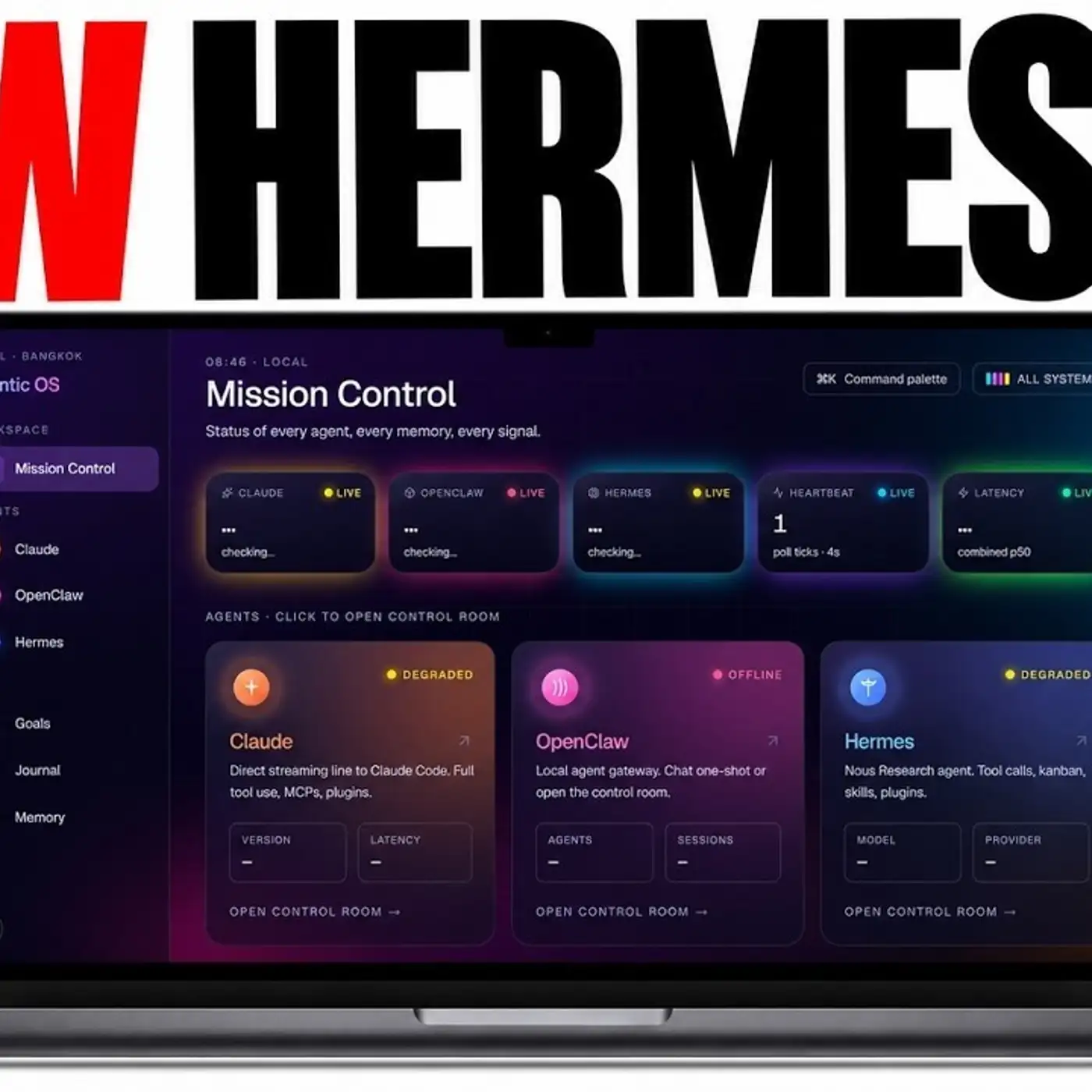
Julian demonstrates how he built a personal “agent operating system” that runs multiple AI agents inside one browser dashboard, where agents share a memory system and work while he does other tasks, despite him not being able to code. He contrasts “using AI” like a vending machine with “building with AI,” and defines an agent OS as a single dashboard that holds all agents, goals, and shared context. He explains the three components—front (dashboard), team (specialized agents), and brain (memory)—and walks through building them in order by describing requirements to Claude in plain English. He stresses starting with one agent to avoid overwhelm, then adding more. For memory, he shows a simple text-file brain (or Obsidian) that agents can read and update so they sound like you and improve over time, and he offers a done-for-you zip-file version with a roadmap and coaching.
00:00 Agent OS Overview
01:00 Using vs Building AI
01:20 Front Team Brain Framework
02:06 No Code Mindset Shift
02:50 Build the Dashboard
03:47 Build One Agent First
04:52 Shortcut Offer
05:24 Build the Memory Brain
07:00 Real World Use Cases
07:38 Final Mindset and Recap
08:35 Step by Step Action Plan
09:26 Closing
Julian demonstrates how he built a personal “agent operating system” that runs multiple AI agents inside one browser dashboard, where agents share a memory system and work while he does other tasks, despite him not being able to code. He contrasts “using AI” like a vending machine with “building with AI,” and defines an agent OS as a single dashboard that holds all agents, goals, and shared context. He explains the three components—front (dashboard), team (specialized agents), and brain (memory)—and walks through building them in order by describing requirements to Claude in plain English. He stresses starting with one agent to avoid overwhelm, then adding more. For memory, he shows a simple text-file brain (or Obsidian) that agents can read and update so they sound like you and improve over time, and he offers a done-for-you zip-file version with a roadmap and coaching.
00:00 Agent OS Overview
01:00 Using vs Building AI
01:20 Front Team Brain Framework
02:06 No Code Mindset Shift
02:50 Build the Dashboard
03:47 Build One Agent First
04:52 Shortcut Offer
05:24 Build the Memory Brain
07:00 Real World Use Cases
07:38 Final Mindset and Recap
08:35 Step by Step Action Plan
09:26 Closing
Full transcript
Today, I'm going to show you how I built my own agent operating system and how you can build your own too. So look at my screen right here. This is my agent operating system. I built it myself from scratch, and it's one of the most powerful systems and setups I've ever made.
Now, you see all these agents down on the side. One can write my content, one could do my SEO, one can plan my day, one holds everything it knows about me, and they all live inside one dashboard. They even, for example, share a memory system here, and they work whilst I'm doing other things. And here's the part that will surprise you.
I don't code. I can't read code. I built this whole thing just by talking to Claude in plain English, and it was way easier than I expected. So in this video, I'm going to show you exactly how to build your own.
First, I'll show you the three simple pieces every agent operating system is made of. Then I'll show you how I got Claude to build the dashboard for me, word for word. Then the one rule that stops you getting overwhelmed when you build your own AI agents. And right at the end, I'll show you the memory system, the thing that makes every agent sound like you, not just generic AI.
And that plot ties the whole thing together, so stick with me. And let me start with what most people get wrong about AI. Most people are using AI like a vending machine. You walk up, you type a question, you get an answer, you walk away, one question, one answer, over and over.
That's using AI. But what I'm going to show you is building with AI. And the gap between two groups and those two people is getting wider every single month in 2026. So what's an agent operating system?
Think about the operating system on your phone. It holds all your apps in one place. It runs everything, it remembers your stuff. An agent operating system does that for your AI.
Instead of Claude in one tab, your SEO tool in another, your notes somewhere else, it's all in one dashboard. All your agents live there. They know your goals, they know and share one memory, and they work for you. And here's how I think about it.
Three pieces. That's the whole thing. I call it the front, the team, and the brain. The front is what you see, the dashboard, the screen with your agents on it.
The team is your agents. Each one has a job. One writes content. One handles your SEO.
One plans your day. And the brain is the memory. It's where your agents keep everything they know about you, your goals, your business, your style. Front, team, brain.
Hold on to those three because we're going to build them in that order. Now, here's a belief that I need to break before we go further. You're probably thinking, Julian, I'm not technical. I could never build something like this.
Stop right there because I'm living proof that's wrong. When I built mine, I wasn't building as a developer. I was building as a business owner who wanted a better setup. Claude handled all the technical stuff.
What I brought was clarity. I knew what I wanted. I could describe it. I could say, that's not right.
Change it. That's not a coding skill. It's a thinking skill. If you run a business, you already have it.
And I'm not the only one. Inside the iProfit boardroom, I've helped over 3,000 business owners build setups like this. People with no coding background at all. Some have never used AI before.
They started. They got stuck. They asked. They kept going.
And if they can do it, so can you. So now let me show you how to actually build it step by step. Step number one, you want to build the front, the dashboard. So what you're going to do is you're going to open up Claude and describe what you want.
That's it. Here's almost word for word what I typed. Build me a personal AI dashboard. It should have a sidebar with different agents I can talk to.
Each agent has its own job. I want to run in my browser and look clean like a command center for work. Claude came back with a real working dashboard in my browser from a few sentences. And from there, every new feature was just another sentence.
So for example, I said, add a voice button so I can talk to it. Done. I said, add a goal section so I can see what I'm working on. Toward.
Done. Right. I wasn't writing code. I was just having a conversation.
I'd ask it for something. Claude built it. I'd look at it and I'd say, good, or change this back and forth. That's the whole build.
Now here's a skill that actually matters. It's not coding. It's knowing what you want and being able to describe it clearly. Knowing what good looks like.
That's a business skill and it's learnable fast. Step number two is you want to build the team. But here's the most important part of the whole video. Start with one agent.
Just one. When I first built mine, I made a classic mistake. I tried to build everything at once. The full dashboard, voice memory, five agents, all in one.
Wrong move. I got overwhelmed and stuck. So here's what I'd do instead. Build one agent, give it a job, get it working.
You could start with, for example, Hermes, then add the next one. The first agent I'd build today with is like a simple setup for Hermes. You can open it in the morning. You tell it what's on your plate.
It asks you a couple of questions and it helps you sort your day. Pretty simple, but already more useful than what most people have. Now, each agent inside the system is just an AI with a set of instructions telling it its job, right? One is your content writer.
One is your SEO helper. One plans your day. You write those instructions in plain English too. So for example, you can just say, Claude, build me a content agent.
Here's how I like to write my content. Here's how I like to write. Once that's working, you add another, then another. And here's the thing.
Every agent you add makes the whole system more powerful. They start to stack up. That's why you don't rush it. You build one solid piece at a time.
Now, if you'd rather not build this yourself and just want my exact system, here's a shortcut. Inside the AI Profitable Room, I actually hand you my whole agent operating system. It's a zip file, quick install, and it's running the dashboard, the agent's memory setup, all done. You can plug your own agents straight into it.
You also get a 30-day roadmap that walks you through setting up for your own business step-by-step, plus a video tutorial for every part. And on our four weekly coaching calls, you can share your screen, show me your setup, and I'll help you build it out live. Link in the comments description or go to theaiprofitableroom.com. Now, step number three, and this is the one that changes everything.
You build the brain, the memory. Now, here's the problem with normal AI. It has no memory. Every chat starts from zero.
It doesn't know who you are. It doesn't know your business. It doesn't know what you did yesterday. So you waste time explaining yourself over and over every single time.
That's fine when you just mess it around, but when you want a system you rely on every day, it's going to really hurt your productivity. The brain fixes that. And the simplest version is so easy, you can do it today. You can just open up a plain text file.
You write down who you are, what your business does, who your customers are, what your goals are, what you're working on right now. Save it. That file is your brain. I actually use Obsidian for this, super powerful stuff.
And now hand that file to your agent at the start of a chat. Boom, it already knows about you. It understands instantly and it's instantly more useful because it has more context that chat GPT or these sort of generic AIs wouldn't have. That's the starter version.
Here's how I do all mine now. I keep all my notes in Obsidian. It's just a folder of plain text files. My agents read it automatically.
So every time I open up my dashboard, my agents already know who I am before I type a single word. And here's the clever part. My agents don't just read the brain, they update it. After we work on something, they save what we did back into it.
So the system gets smarter every day. The more I use it, the better it knows me. It's a loop that keeps building on itself. That's the difference between a filing cabinet and a personal assistant.
A filing cabinet just holds your stuff in a pile. A personal assistant knows you, remembers everything, and it's ready to work. Your agent operating system is the assistant, built for you, awake 24-7, never tired, never forgetful. Let me make this real with how it plays out in your day.
Let's say, for example, a totally random thing. You run a salon. You open up your content agent and you say, write this week's post. It already knows your salon, your tone, your offers, done in minutes.
Let's say, for example, you do SEO for clients. You open up your SEO agent. You say, draft an article on this keyword. It's already understanding of your content style, what keywords have worked before, and it's done.
Let's say, for example, you're a coach. You could say to your planning agent at 7am, which already knows your goals, what should I work on today? And it helps you pick what actually matters. You see, so there's no code, there's no technical words, just agents that know you're doing real work.
Now, here's the last belief I want to break because it's the one that probably keeps most people frozen. You're probably thinking it's too late. Everyone else is already way ahead of me, and I get it, but here's the truth. I built mine through trial and error.
I made the classic mistake of doing too much at once. I got stuck, I fixed it, and there was no head start, just one piece at a time, over and over. The people winning with this aren't smarter than you. They just started building instead of just using.
And honestly, I regret not starting sooner. I keep thinking, why didn't I build this back in January? So don't wait like I did. The door is wide open today.
So let me bring it down. The old way, you jump in between tabs, Claude here, note set, re-explain yourself all the time. You're the glue, holding it all together, and you're the bottleneck. The new way, you build one system, the front you can see, the team that does the work, the brain that knows you.
You describe what you want, Claude builds it, and you layer it up one piece at a time. You stop being a user, you become the boss and the operator of a team that works for you. That's how I built mine, that's how you build yours. If I was to implement this all again today, or if I was in your position, don't try to build everything at once.
Pick one thing, one job you do every week that you set up your time, open up Claude, describe a simple dashboard of one agent for that job, get it working, then add your memory file, then add the next agent, and that's the whole path. And if you want to skip the trial and error and just start with what already works for me, my agent operating system is waiting inside the AI Profit Boardroom with a quick zip file, install the dashboard, the agents, the memory system, all ready built for you. You plug in your own Claude, your open Claude, your SEO and video agents, and run them from one place. You get the 30-day roadmap to set it up for your business, the full video tutorials and daily updates, as I make the system better.
Plus you get four weekly coaching calls every week where you share your screen, and I help you push it further live. Link in the comments description or head to the AIProfitBoardroom.com. Pick one job, describe it to Claude, build the front, add your team, give it a brain, one piece at a time. Thanks for watching.
More episodes