watch the video
play the audio
MiniMax M3 + Hermes AI: The Agent OS That Generates Images, Video, and Voice in One Dashboard
The script demonstrates a “mission control” Agent Operating System built with MiniMax Studio and Hermes that generates images, videos, and voice in one interface, contrasting it with the old workflow of juggling multiple chatbots and apps where you act as the glue and AI forgets context. It argues the new approach is a team of AI agents (Hermes, Claude, OpenClaude) sharing memory in one dashboard, powered by the newly released MiniMax M3 (June 1) with about a million-word context window. The speaker highlights MiniMax’s internal tests claiming M3 can work autonomously for about 24 hours, making 1,959 moves and 147 attempts, outperforming models that quit after ~30 tries. The system saves outputs into organized workspaces, and the speaker promotes the AI Profit Boardroom for setup resources and coaching, noting M3 can be tried via Ollama and announced as open weights.
00:00 Minimax M3 Shockwave
00:04 Mission Control Demo
01:05 Chatbot vs Agent Team
01:50 Old Way Is Broken
02:38 Agent OS Explained
03:20 M3 Memory Upgrade
04:34 Autonomy Marathon Benchmarks
06:25 Hermes Body Meets M3 Brain
07:43 Studio Workflow And File System
09:03 Setup Help And Boardroom Pitch
10:16 Try It With Ollama
10:59 Connect The Dots And Final Call
The script demonstrates a “mission control” Agent Operating System built with MiniMax Studio and Hermes that generates images, videos, and voice in one interface, contrasting it with the old workflow of juggling multiple chatbots and apps where you act as the glue and AI forgets context. It argues the new approach is a team of AI agents (Hermes, Claude, OpenClaude) sharing memory in one dashboard, powered by the newly released MiniMax M3 (June 1) with about a million-word context window. The speaker highlights MiniMax’s internal tests claiming M3 can work autonomously for about 24 hours, making 1,959 moves and 147 attempts, outperforming models that quit after ~30 tries. The system saves outputs into organized workspaces, and the speaker promotes the AI Profit Boardroom for setup resources and coaching, noting M3 can be tried via Ollama and announced as open weights.
00:00 Minimax M3 Shockwave
00:04 Mission Control Demo
01:05 Chatbot vs Agent Team
01:50 Old Way Is Broken
02:38 Agent OS Explained
03:20 M3 Memory Upgrade
04:34 Autonomy Marathon Benchmarks
06:25 Hermes Body Meets M3 Brain
07:43 Studio Workflow And File System
09:03 Setup Help And Boardroom Pitch
10:16 Try It With Ollama
10:59 Connect The Dots And Final Call
Full transcript
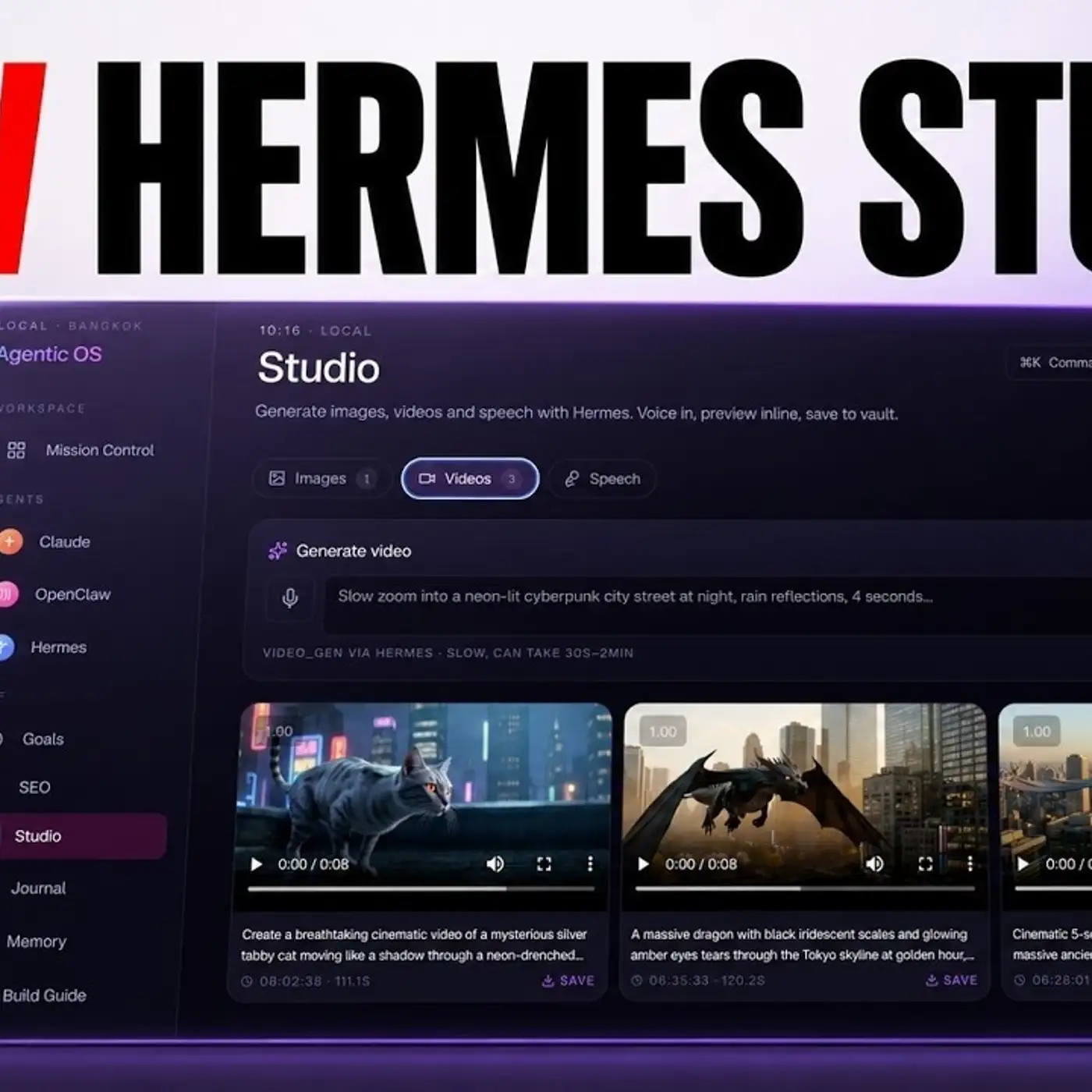
Minimax M3 plus Hermes AI just changed everything. Let me show you what I mean. So for example, I've built out of this mission control, we've Minimax Studio built in. And what this means is I can just generate images, I can generate videos and voice in one single tab in this beautiful mission control, like you can see.
And then also this is super fast. So for example, if we just give it a random example, like, okay, create a dragon flying over Tokyo as an example of that, that's gonna generate an image and it creates it very quickly on my own tests directly inside this studio. And so recently I built out this agent operated system, something I've been waiting for for a long time, called my agent OS. And this week Minimax and Hermes made it 10 times more powerful.
So let me walk you through it because I think it changes how you think about AI for your business. Here's a big idea first. This is one thing I want you to segue. By the way, look at that image, how good quality is that, right?
And then also you've got the videos that you can generate here as well. So if we play these back, let me show you the quality of these videos is absolutely wild, right? Really nice. So basically the way that I'm looking at this is most people are using Hermes as a chatbot.
Let me show you an example. So if we pull up Hermes inside the chat here, most people are just going back and forth with Hermes inside the terminal and it doesn't look anywhere near as good. So I started to think about AI agents as really my team that I could build around this whole process. And if you stop thinking about Hermes as this sort of terminal and start thinking about how can you control it, how can you build out a team of AI agents that can create images, videos, podcasts, even using this whole setup and then save everything in one place so that you can preview it and use it whenever you want to, well, that's gonna make it way easier and more powerful and more autonomous, right?
So the old way, for example, and this is probably the way that you've been using AI without even realizing is, you know, the old way is this, you go into, for example, your terminal and you open up Hermes, you type a question, it answers, you might get it to do something and then you might paste that output somewhere else or you try and open it up in Finder. Maybe you do the next bit, you copy that, you paste it again, but you're glue, right? You're running between 10 different apps. Maybe you've got Hermes, maybe you've got Claude somewhere else, maybe you've got ChatGPT somewhere else as well.
And so you're running between like 10 different apps, holding it all together with your own two hands. And the second you close the tab, the AI really does forget everything. You know, it's got a memory, it's not that great, you start from scratch every single time. And that's not really having a team, that's just kind of like a vending machine where you put in a question, an answer falls out and it forgets you the moment you walk away.
The new way is completely different. This is where an agent operating system comes in. So picture a mission control, one screen, and on that screen, all your AI workers sit side by side. So Claude, open Claude, Hermes, they all live in one place, they all share the same memory, they actually know what the others are doing, they're a team, not a pile of strangers.
And that's the agent operating system. So you have one dashboard, everything is ready to go. You don't even need to type Hermes into the terminal. And then this is where it all changes because with the new model, Minimax M3, they literally just dropped about 24 hours ago, something like that.
We've plugged it in to this agent operating system and turned it into a proper studio that runs itself. And here's why it's a big deal. So Minimax M3, it just dropped on June the 1st, right? So it really just came out and it has a giant memory.
So M3 can hold about a million words in its head at once, a million. So imagine, for example, having a stack of books taller than you in front of you, and it remembers every single page whilst it works. So if you look at that versus smaller models, this is way more powerful because it has a much better memory. It remembers every single page whilst it works.
The old AI was a bit of a goldfish. This one never really forgets your stuff. Now, why does that matter for you? Well, you can hand it the whole thing, all your notes, every past email, your entire content folders.
It can work with the full picture, not a tiny slice. So for example, like a freelancer could drop in every client brief they've ever written and ask it to find what their best projects had in common. Number two, and this is where it gets really powerful, is that Hermes agent can create images, it can create videos, and it can create sound. So it's not just a writer.
It can look at things, it can create things, it can build things, and it can turn Hermes from like a basic sort of chat interface to something that's a full studio. Not only that, but you've got the power of, for example, like Hermes goal mode. Now, this is really important here as well because Minimax M3 in particular can work on its own for hours. And the test actually found that Minimax could run for 24 hours autonomously on the benchmarks.
You can see that case study right here. Now, I want to be careful, because these numbers come from Minimax's own tests, not from outside checkers. But here's what they showed. They handed M3 one brutally hard job, no answer to copy.
They just said, go figure it out. And it ran on its own for about 24 hours straight. It made 1,959 separate moves. It tried 147 different times with no human intervening in the whole way.
So 24 hours alone, nobody in the room. Now, here's the part that I keep thinking about, which is, you know, if you're using chat GPT or even if you're just using Claude most of the time, most other AIs give up. The Minimax team said it plainly. Most models will quit after about 30 tries when they're trying to stop on their own.
M3 didn't. Its best answer didn't show up, actually, until they tried number 145. So it hit wall after wall, got stuck again and again, and just kept going like a refuser who refuses to clock out until the job is properly done. Now, think about how rare that is, not just in AI, but just in the world in general.
Who's gonna work for 24 hours straight and get stuff done like that? There's very few things, right? So why should that matter to you? Because the jobs that eat up your week aren't the quick ones.
They're the long, grindy ones, sorting years of data, going through a giant spreadsheet line by line, cleaning up a huge, messy document. Those are exactly the jobs that need a worker who won't quit at try number 30. So for example, you could hand it like a year of messy invoices and just let it sort and check that, you know, every single one overnight, and that's a difference. So the old AI was a sprinter, good for a quick burst, then done.
But M3 is actually a marathon runner. Let's test another thing. So we're gonna create a video, a cinematic aerial flyover of a dragon flying over a growing futuristic city at night, and we'll hit generate on that, and then we'll start generating the video. Now, whilst we're waiting for that, let's talk about this, because this is where it gets fun.
You know, a smart brain on its own just sits still there, right, you have to talk to it, you have to babysit it, and that's still the old way. But when you actually think about this, what you want is a worker. You give it a job, you walk away, you come back to finish work, and that's where Hermes comes in. So Hermes is an AI agent, M3 is a brain you plug in, Hermes is a body, the brain thinks, the body goes and does the work.
It can open files, it can run tools, it can make the thing, and it keeps going on its own. And so basically what I did here is I took the brain, logged it into Hermes, and now both of them sit inside my agent OS, sitting next to it, clawed an open claw, all sharing the same memory as well. And this is one of the other cool things about using M3 in particular, is because it's a very powerful model with a million token context window, it holds a lot of memory, it works very well with memory. And so it can, for example, update my notes, organize my memory vault, and then also it can organize those notes into a beautiful system like you can see right here.
Not just that, but this is where it gets really interesting too. So you can turn this full setup into a studio as well. And the big difference here is like, if you look at the old way, how are you gonna find the images that you created? How are you gonna find the videos that you created?
How are you gonna see all the projects that you've created inside Hermes directly inside the terminals? It's gonna be very hard for you, right? Whereas for example, if you go inside the workspace that we've set up in the agent OS, you see how you can see all the projects that we've created previously. We can, for example, preview videos that we've created previously.
We can see the images of everything that we've built out. And so it's just a lot more powerful because you can access everything and you save time in one single place. And so inside Hermes, what I actually did was just build a simple box and you can type what you want and make it. So that could be an image, it could be a short video, it could be a voiceover.
And then it saves everything into neat folders for you. So when we create all this stuff, not only can we preview it between the tabs, but also we can go to the workspace and see everything inside the individual folders, which is great too. And so in one window, you could, for example, write a script, generate a voiceover, make images, et cetera, all in one place, all connected, all saved automatically. And before this, you'd need like five different apps and five different logins to do it.
Now it's inside one dot box, inside one dashboard running on one brain that doesn't forget and a body that doesn't quit. That's the agent operate system. And it's really the new way here. Now, if you're sitting here thinking, this sounds amazing, but there's no way I could set this up.
I'm not techie. I hear you. That's the number one thing most people tell me. And I'll be straight with you, like doing this on your own can be a little bit messy.
There are tokens and folders and settings, and you know, it's difficult to organize. That's actually why I created and built the AI Profit Boarding the way I did. We've got over 3,300 business in there and a huge chunk of them have never touched AI before they joined, total beginners. But inside, we built a 30 day roadmap for setting up your own agent operating system.
We actually give you the zip file for using the system that I use. And we also show you where you can plug in Hermes and Minimax and Claude so they work as one team. So you get the zip file to start from, a video tutorial for everything, four live coaching calls per week, where you can share your screen and someone walks you through the whole process on the spot. And when you get stuck, you're not alone because there's always people online 24 seven.
You see right now, 110 people online to help you. Link in the comments description or go to the AIProfitBoarding.com. Now, if we go back, we've actually got the video generated, as you can see. And look how amazing that looks, right?
Super beautiful, great quality. I would actually say that I've tested out Grok for generating videos and images with Hermes. And I would genuinely say it looks a lot better with Minimax. And there's also one more thing about M3 that might be important to you too, which is that you can actually test it out.
So you can test it out with Olama. Try it out. They're actually releasing it open source as well. So if you've got a really good setup for local models, you'll be able to run it.
And you can set this up in one click with OpenClaude, with Hermes Agent, with Codex OpenCode, Codex App, and Claude Code as well. That's with Olama. So they've already got that running. And bear in mind, this is cloud, so it's gonna be quick to set up even if you don't have a good local setup.
But they've also announced that it's gonna be an open weight model. So that essentially means that they'll be releasing it in a few days on Hugging Face. And if you've got a really good local setup, then you'll be able to run the model locally as well, which is absolutely amazing. So let's connect the dots because this is the full picture of the new way.
You've got a brain that holds a million words and won't forget your business. You've got a body which is Hermes that does the work without you watching. You've got a studio that makes your images, videos, and voiceovers inside one beautiful interface. And then you've got them all sitting inside one dashboard in the agent operating system, sharing one memory, working as a team.
And also, you can even orchestrate different agents to get stuff done, like you can see inside this Kanban right here. And all you do is you plug in the task that you want to get done. Now, I know some of you are thinking, this is moving too fast. Like there's a new thing every month.
There's a new thing every week. I'll wait until it settles down. And I get it. I really do.
But the ground keeps shifting. And the honest truth here is it's not gonna settle down. The people we know aren't the ones who wait for the dust to clear. They're the ones who started whilst it was messy because by the time it feels like simple and easy to use, the early folks are gonna be miles ahead, right?
And they will have automated everything. So I'm saying this because I watch it happen inside our community every single week. And let me talk about another thing here as well. The other cool thing about this is you don't need to be technical, right?
A few people say, I can't do this. I'm not a coder. But you actually don't need to be. None of what I just showed you needs code.
It just needs you to know how to set it up and how to point it at the right job. That's a skill in itself. Like any skill, it's learnable. Like beginners in our group are doing that right now to build their own agent operating systems and mission controls.
And so these are people who a few months ago had never opened up an AI tool before. So here's where I'll leave you. The brain got bigger. The worker got tougher.
The studio fits in one box. And you can also test it out for free with Olama. The only question left is who learns to use it and who keeps working? And if you want to get my agent operating system with the Minimax M3 setup and Hermes as well, running your content, the studio, organizing and creating goals whilst you sleep, that's exactly what we do inside the AI Profit Wardroom.
So you get the full 30-day roadmap to set it up, the zip file to start from, the video tutorials and daily updates as we keep improving it, plus four weekly live coaching calls every week where you can bring your own setup and get help fast. And you're learning right next to members already running Hermes and Minimax for their own work. So you're never left figuring it out alone. Go to theaiprofitwardroom.com or link in the comments description to get access.
The AI just changed. Do not let it leave you behind.
More episodes
China's MiniMax M3 AI Changed Everything