watch the video
play the audio
Hermes Agent Tool Search: Faster AI Agents That Pick the Right Tool (49% → 74%) | Hermes v0.15 Update
The script explains Hermes Agent’s new Tool Search feature and how it fixes a key scaling problem: loading too many tools upfront consumes context window space, slows agents down, and increases wrong tool selection. With Tool Search, Hermes keeps only core tools loaded and retrieves other tools only when needed, improving correct tool choice from 49% to 74% and maintaining speed even with large tool stacks; it activates automatically when tools exceed 10% of context. The video also highlights Hermes v0.15 improvements including faster searches, the ability to split into two specialist agents (planner and doer) that build separate skill libraries over time, and Kanban Swarms for running multiple agents collaboratively. It notes Hermes is open source from Nous Research, works with OpenClaw, can be updated via a terminal command, and showcases examples like generating a local SEO guide, keyword mapping, and video creation.
00:00 Tool Search Breakthrough
00:43 Why More Tools Hurt
02:08 How Tool Search Works
02:58 Auto Activation Explained
03:23 Business Impact Examples
05:18 Hermes v0.15 Extras
06:39 What Is Hermes Agent
07:44 Real Project Demo
08:52 Bigger Picture Shift
09:33 Getting Help Setup
10:28 Final Takeaways
The script explains Hermes Agent’s new Tool Search feature and how it fixes a key scaling problem: loading too many tools upfront consumes context window space, slows agents down, and increases wrong tool selection. With Tool Search, Hermes keeps only core tools loaded and retrieves other tools only when needed, improving correct tool choice from 49% to 74% and maintaining speed even with large tool stacks; it activates automatically when tools exceed 10% of context. The video also highlights Hermes v0.15 improvements including faster searches, the ability to split into two specialist agents (planner and doer) that build separate skill libraries over time, and Kanban Swarms for running multiple agents collaboratively. It notes Hermes is open source from Nous Research, works with OpenClaw, can be updated via a terminal command, and showcases examples like generating a local SEO guide, keyword mapping, and video creation.
00:00 Tool Search Breakthrough
00:43 Why More Tools Hurt
02:08 How Tool Search Works
02:58 Auto Activation Explained
03:23 Business Impact Examples
05:18 Hermes v0.15 Extras
06:39 What Is Hermes Agent
07:44 Real Project Demo
08:52 Bigger Picture Shift
09:33 Getting Help Setup
10:28 Final Takeaways
Full transcript
Hermes agent just added tool search and it changes everything about how your AI agents work. Your agents have been working against itself this whole time. Every extra tool you gave it, well, it was just slowing it down. And the more powerful you tried to make it, the worse it got.
That's what everybody hits with AI agents. Hermes tool search just broke that wall. Now your agent picks the right tool, 4% of the time instead of 49% of the time. It thinks faster, it stays sharp, it handles real work without falling apart.
Stick with me to the end because I'm going to show you one more thing inside this update that turns one agent into a whole team, all running at the same time, all getting smarter the longer they work for you, and how to activate the new tool search update. Let's get into it. These agents' new tool search just changed how AI agents work. And most people building with these tools have no idea how it fixed one of their biggest problems.
Here's what News Research did. They just added a feature called tool search to Hermes agent. And it's sort of something that's been quietly slowing your agents down this whole time. Let me explain it simply.
Think of your agent like a worker. You want that worker to do lots of jobs for you. Send emails, pull data, book calls, search the web. So you give it tools.
Each tool is like a power. The more tools, the more your agent can do, which sounds amazing, right? More tools, more power. But here's the catch nobody told you about.
Every tool you give your agent takes up space in its head. The AI has a limited amount of room to think. We call that the context window. And every tool you load in fills up that room before the agent even starts working.
So picture this. You hand your worker a giant toolbox with 200 tools aside. Every morning before they do anything, they have to read the label on all 200 tools. Even if today's job only needs one.
That's slow. That's messy. And it eats up the room your agent needs to actually think. So the agent gets confused.
It picks the wrong tool. It forgets what it was doing. You've packed its head so full of tool labels, there's no room left for the real work. And this is a thing holding most AI agents back right now.
And almost nobody talks about it because it's boring to explain, but it matters more than any new flashy feature. Now here's what Hermes agent just changed. With tool search, your agent doesn't load up every tool up front anymore. Instead, it keeps a few core tools always ready.
Things like web search and the rest only grabs them when it actually needs them. So the agent looks at the job, figures out what it needs, then reaches back into the toolbox and pulls out just that one tool. Does the work and then moves on. Back to our worker.
Instead of reading 200 labels every morning, they walk up to the shelf, grab the one wrench they need for today's job and go to work. The other 199 tools stay on the shelf ready, but out of the way. And the numbers on this are real. News research actually said when the agent picks a tool the old way, he got the right tool 49% of the time, less than half.
With tool search turned on, that jumped to 74%. So the agent picks the right tool way more often now and it just works better. Now you might be wondering, how do I activate this? Well, here's the smart part.
This feature actually turns itself on. You don't have to flip a switch. The moment your tools fill more than 10% of the agent's thinking space, tool search kicks in automatically. It searches your tools fast and then grabs what fits.
And if you're someone with a huge stack of tools, this is the update you've been waiting for. The more tools you have, the more this helps. Big toolbox, no slowdown. Now let me show you why this matters for your business, even if you've never launched an AI agent in your life.
Most people watching this run a business. You're not a coder. You don't want to be one. You just want AI to do the boring stuff so you can focus on growing.
So think about what an AI agent could do for you. It could check your inbox every morning and flag the leads worth chasing. It could write your follow-up emails. It could pull your sales numbers and put them in one place.
So you could answer customer questions whilst you're offline. But to do all of that, the agent needs tools, lots of them, right? And up until now, the more tools you give it, the slower it got. It would jam up, slow down, pick the wrong tool and sometimes mess up the job.
That's the wall everyone's hitting with AI agents right now. You want a powerful agent that does everything, but the more you ask it to do, the worse it performs. Tool search breaks that wall. Now you can hand your agent 100 jobs and 100 tools and it stays sharp.
It only thinks about what it needs when it needs it. That changes everything for a small business owner, for example, because now you can actually build the AI assistant you've been dreaming about without it falling apart. And I get the skepticism as well. You've probably heard 100 times that some new AI thing is going to change your life.
Most of it is noise. I'm tired of it too. But this one's different because it fixes a real boring problem that was stopping agents from working. It's not a shiny new model.
It's the plumbing getting better. And when the plumbing works, everything you build on top of it works too. Now, if you want to actually use this stuff in your business and you don't know where to start, this is exactly what we do inside the AI Profitable Boarding. We've got daily tutorials walking you through how to set up Hermes agents step by step, how to load your tools the right way and how to use a new tool search so your agents stay fast and pick the right tool every time.
Plus how to actually implement this stuff inside your business. We've helped over 3,200 business owners do this. A lot of them have never touched AI before they joined. You ask questions, you get answers and you build the thing live with people who have already done it.
Link in the comments description or go to the AIprofitboarding.com. Now, let's keep going because there's more to this update than just tool search. This came as part of the Hermes V0.15 update and a few other things actually shipped with it that make Hermes a real contender. First, the searches themselves got faster.
So when your agent goes looking for a tool, it finds it quicker, which means less waiting and more doing. Second, and this one's interesting, Hermes agent can now split itself into two specialists. One agent plans to work, the other does the work. And here's the part that surprised me.
Each one builds its own skill library over time. So they actually learn. So your planning agent gets better at planning. Your doing agent gets better at doing.
They don't share one brain. They each have their own memory, their own skills, their own focus. Think about what that means, for example, for you. It's like hiring two workers instead of one.
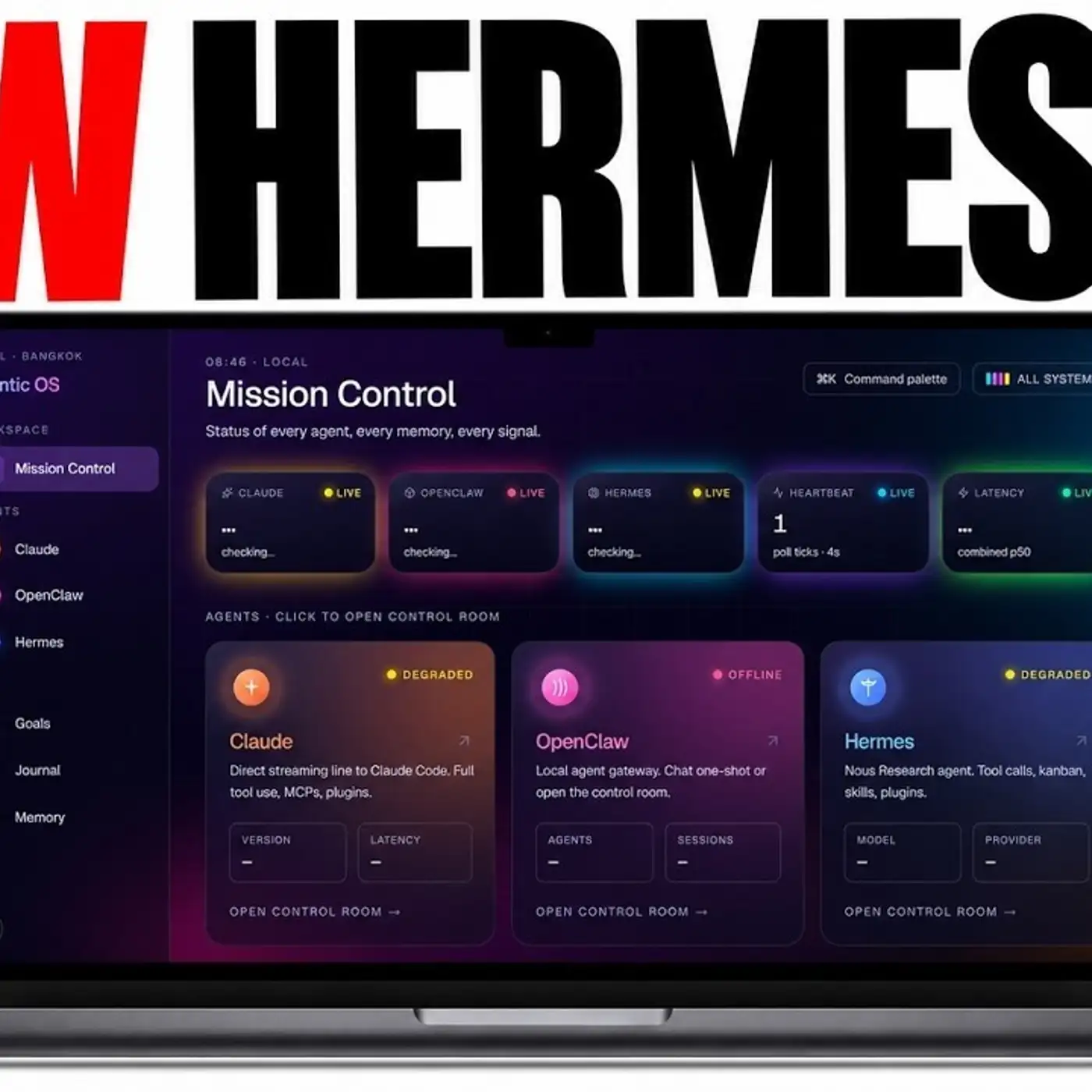
A manager who maps out the day and a doer who knocks out the tasks. And both get smarter the longer they work for you. There's also something called Kanban Swarms in this update. We've actually built it into our agent operating system for Hermes, like you can see.
Without getting too deep, it just means you can run a bunch of agents working together on a board, like a team passing tasks back and forth. So one agent finishes the job, hands it off, the next one picks it up. And all this updates with one simple command. You literally just type in your task here.
So you don't need to reinstall anything. You don't start over. One line and you're on the new version. And that's the kind of thing that keeps you from falling behind without burning your whole weekend on setup.
Now let's talk about Hermes itself for a second, because some of you are hearing this name for the first time. Hermes agent comes from News Research. It's open source, meaning anyone can use it and build on it. It goes head to head with OpenClaw and a lot of people switching over to it.
There's even a tool to help you move from OpenClaw to Hermes. What makes Hermes stand out is its self-learning improvement loop. It just gets better and better the more you use it. And also it's very smooth.
That's why people are running it autonomously as an AI agent. And now with tool search, that employee got a whole lot sharper. By the way, if you want to update to the latest version, just type in Hermes update inside your terminal and you can update your Hermes agent from there. But basically before, all those memories and skills and tools were sort of conflicting with each other for the same tiny bit of thinking space.
Now the tools step aside until they're needed and the agent has room to actually use everything it's learned. That's a big shift here. So the old way, you have to pick, either give your agent a lot of tools and watch it get slow and confused, or keep it simple and limit it to what it can do. The new way is you don't pick, you give it everything, it stays sharp because it only pulls what it needs in the moment.
That's a real change, not a flashy headline, but a real one. Let me give you a real example here. So for example here, you can see that we actually asked it to create this local SEO guide, as you can see right here. And it broke it down into steps, assigned all of the creation of this to multiple AI agents, formatted it beautifully, came up with all the relevant content ideas, broke it down into a 30 step implementation plan and formatted it.
And we've got it in a nice workspace right here. We've got another one here, which is a keyword map. As you can see with keyword clusters, with pillars, with a review of all the keywords by priority, volume, difficulty and page. And also a list of quick wins to implement right here.
So it's really powerful for planning out a big project, giving it a big mission and then letting it go off and do everything. And bear in mind, it uses a lot of tools to do that. I mean, here's another one. So for example, if you've trained it to create videos like we have, it can create beautiful videos like you can see, but it's not going to load that tool all the time, right?
It's just going to load it when it actually needs it, which makes it faster and it doesn't get slowed down, even though we teach you more stuff. So that's what this unlocks. Basically real agents that can handle real work without falling apart the second you ask them to do one more thing. And here's the bigger picture I want you to walk away from.
Like a year ago, building an AI agent that could do more than one or two things was very hard, right? It would break, it would hallucinate, they'd forget. Most people gave up and went back to doing things by hand. That's changing fast.
Every month these tools get a little bit more solid. Tool search is one of those quiet upgrades that doesn't make the headlines, but makes the whole thing actually usable for a normal business owner. So if you've tried AI agents and got frustrated because they were flaky, it's worth another look. The ground underneath you shifted and the thing that broke last time might just work now.
And if you've never tried, this is a good moment to start, right? Not because some model got bigger, but because the tools around it are finally getting more reliable. That's the part that matters for you. And here's the honest truth though, knowing about this one thing, setting it up and getting it working in your actual business is another.
That's a gap that trips most people up. They watch a tutorial, get excited, open the tool and have no idea where to start next. That's the whole reason the AI Profit Boardroom exists. Inside, we've got coaching calls four times a week where you can bring your Hermes setup and we'll help you get it running right.
We show you exactly how to use tool search, how to set up your agents, how to actually get them implementing stuff inside your business to generate more leads, to save you time to handle customers. We've got a step-by-step tutorial for implementing all this stuff, a prompt library, the agent OS system inside there too. And a map so you can find other members near you who are building the same thing. We've got over 3,200 members inside there.
You can see some of the amazing results we're getting people and plenty of people here have started knowing nothing. So if you feel like you're behind, this is a great place to start and a great place to join. Link in the comments description or go to the AIProfitBoardroom.com So here's where we land. Hermes agent tool search fixed a problem that was quietly holding back every AI agent with a lot of tools.
Your agent now loads only what it needs, picks the right tool way more often, 49% up to 74% and stays fast even with a giant toolbox. Add in the faster searches to split specialist agents that learn over time and one command update and Hermes just got a lot more useful for regular people running a normal business. The agents are getting good, not perfect, but good enough to actually help you right now. The question isn't whether this stuff works anymore, it's whether you're going to learn how to use it before the people you compete with do.
More episodes