watch the video
listen on apple podcasts
play the audio
Claude + Agent OS: The Command Center That Fixes AI Memory, Chaos, and Busywork
The script explains why using Claude (or any single AI) feels frustrating because it forgets context when you return, forcing you to start over, and contrasts this with an “agentic operating system” that puts all your AI agents on one dashboard with shared memory. The speaker describes a command center where agents like Hermes, OpenClaude, Claude, and others work side-by-side, track what you did yesterday, and store knowledge via an Obsidian-based memory vault. The system includes mission control, individual agent rooms with chat and a live workspace for outputs (images, videos, podcasts), plus a Kanban board agents can move tasks through, a journal, goals page, and a studio for content creation. The speaker claims thousands of business owners have set it up, offers a zip file, tutorials, updates, and coaching via the AI Profit Builder/Boardroom.
00:00 Why Claude Forgets
00:25 Meet Agent OS
00:56 Operating System Analogy
01:53 Command Center Dashboard
02:47 Inside Each Agent Room
03:28 Shared Memory Vault
04:33 Beginners Can Do It
05:10 Get The Full Setup
05:43 Kanban Tasks And Studio
06:55 Agents Work While You Sleep
07:38 Honest Limits Real Tools
08:10 OS Outlasts Agents
08:23 Handling Common Doubts
09:22 The Real Edge Today
09:46 Your Next Step
10:10 Time Back And Final CTA
The script explains why using Claude (or any single AI) feels frustrating because it forgets context when you return, forcing you to start over, and contrasts this with an “agentic operating system” that puts all your AI agents on one dashboard with shared memory. The speaker describes a command center where agents like Hermes, OpenClaude, Claude, and others work side-by-side, track what you did yesterday, and store knowledge via an Obsidian-based memory vault. The system includes mission control, individual agent rooms with chat and a live workspace for outputs (images, videos, podcasts), plus a Kanban board agents can move tasks through, a journal, goals page, and a studio for content creation. The speaker claims thousands of business owners have set it up, offers a zip file, tutorials, updates, and coaching via the AI Profit Builder/Boardroom.
00:00 Why Claude Forgets
00:25 Meet Agent OS
00:56 Operating System Analogy
01:53 Command Center Dashboard
02:47 Inside Each Agent Room
03:28 Shared Memory Vault
04:33 Beginners Can Do It
05:10 Get The Full Setup
05:43 Kanban Tasks And Studio
06:55 Agents Work While You Sleep
07:38 Honest Limits Real Tools
08:10 OS Outlasts Agents
08:23 Handling Common Doubts
09:22 The Real Edge Today
09:46 Your Next Step
10:10 Time Back And Final CTA
Full transcript
Claude plus agent OS is absolutely insane. And once you see this, you can't really unsee it. The problem nobody talks about is like you opened Claude. You know, you ask it to do something.
If we give you an example right here, it gives you a great answer. You close the tab. The next day you come back and Claude has no idea about anything, about what you've created, what you were doing. You kind of just started from scratch again.
The memory isn't very good and you start over and over again every single day. Now picture this instead. So you open one screen. Claude is right there, but so is every other AI agent you've ever created and everything else that you've done.
That is Claude with an agentic operating system because you've got all of your agents ready to go. You got Hermes, OpenClaude, Claude, FreeClaude, Code, all of them on one dashboard, all sharing the same memory, all knowing what you did yesterday, all ready to work. That is an agent operating system and it changes everything. Let me show you why this matters so much.
Think about your computer for a second. Your laptop has an operating system, right? Could be Windows, could be Mac, and without it, your laptop is just a brick. The screen, the keyboard, the apps, none of them actually talk to each other.
The operating system is the thing that makes work together. It's the boss, it's mission control. Now here's the thing that most people miss. AI agents are the same.
Claude is powerful, like really powerful, insanely powerful. Probably one of the most powerful tools that humankind has ever had. But if on its own, it's just like an app with an operating, with no operating system, it can't remember, it can't talk to your other tools, it can't really track what matters to you. And the old way was simple, right?
So you had one AI, maybe you were going to chat GBT and you typed in a box, you got an answer, it was done. The new way is very different because you have a whole team of AI agents and they need a place to live, a place to work together, a place to remember. They need an operating system. They need an agent OS.
And that is what I've built, as you can see right here. I call this a command center because that's exactly what it is. It's one screen where you sit like a captain on a ship and every other AI agent responds to you. You can see what they're doing.
You give them jobs. You watch them work in real time. And the cool thing about that is we can ask Hermes to do something. And then we could also ask Claude to do something at the same time.
And so most people are still flying blind. 10 tabs open, Claude in one, some other tool in another. Copy this, paste that, lose track, start over. It's absolute chaos.
The command center kills that chaos because everything is in one place. Now, let me break down what's actually inside this thing, because this is where it gets really powerful. So first of all, you've got the mission control. This is the front page.
And when you open it, you see all your agents line up, right? Are they online? What are they doing right now? It's like a dashboard in a car, one glance and you know everything.
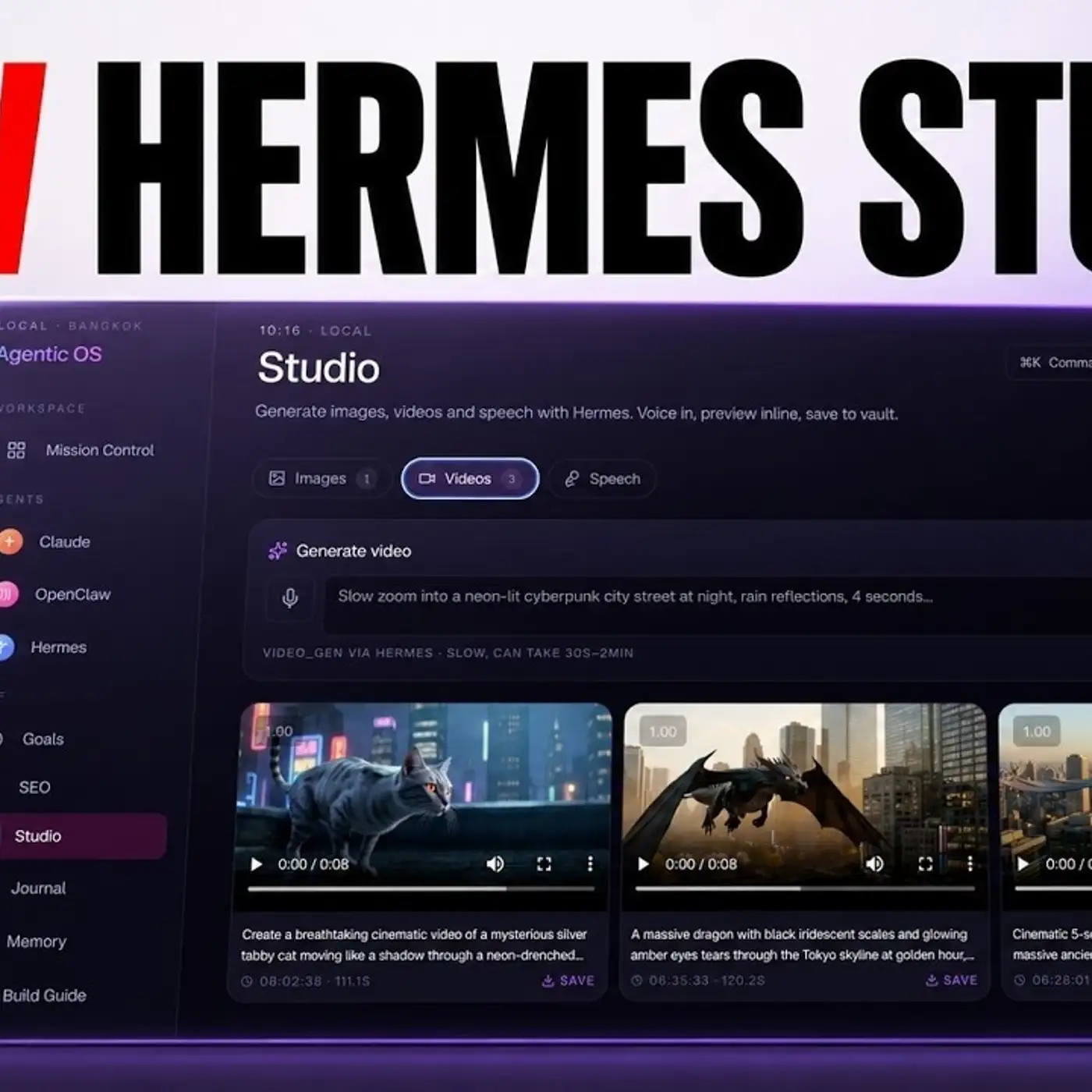
And then each agent gets his own room. Claude has a room. You can chat with it right there. Next to the chat, there's a workspace.
So when Claude builds something that could be a page, an image, a video, it shows up right there and you click it. It plays. You don't go hunting through folders. It's all right there.
If we want to check out the podcasts that we've built, we can check them out here. If we want to check out, for example, the images we've built, here we go, right? If we want to check out some videos we've created, no problem. Everything is all there, ready to go in one beautiful place, right?
And the great thing about this as well, you can preview everything in real time as well. Now next to the chat, there's a workspace. So you've got it right here. This is where you can preview everything.
And also you've got the part that I absolutely love. This is one of my favorite parts, which is the shared memory system. Now, the way this works is we actually built something called Obsidian into the agent operating system. And this is the thing, right?
The memory is the difference between a tool and a teammate. A tool forgets you the second you walk away. A teammate remembers. A teammate picks up where you left off.
That's what shared memory gives you. The quick question for you, right? How many times have you explained the same thing to an AI over and over? Your business, your customers, your goals, every single time from scratch.
And it's pretty exhausting, right? So with the agent operating system, you explain it once and it remembers forever. And I've actually set up a system inside the iProfit Boardroom where my agents take notes on me autonomously and they use that and then document it inside my memory vault. So I have all my memories stored and then I can come back to them and we're ready to go.
So if you're sitting there, you know, thinking, I really don't want to re-explain, I'm spending half my time re-explaining myself to my agents and giving them context. Well, this is what can help you so much. And here's the other thing, you know, I've helped over 3000 business owners inside the iProfit Boardroom set this stuff up and what shocks people is a lot of them have never used AI before, never, like total beginners. And they got an agent operating system.
Set up as you can see right here, John absolutely crushed it with his. So if you sit and sit in there, like thinking, oh, this is too technical for you. I hear it a lot and I get it. But that belief is the only thing in your way, because people have never touched AI before running their own command centers right now.
And if they can do it, you can do it. You can see all these testimonials from the iProfit Boardroom right here. Um, and you know, if they can do it, you've got it in you as well, right? Anyone can do this.
So if you want the exact setup with the zip file, with the agent operating system and Claude wired into it, we've actually got it inside the iProfit Boardroom. So you get the full setup. You get the zip file. You get a video tutorial walking you through every single click and daily updates as we've made the system better.
Plus four weekly coaching calls every week where you can ask questions about your own agent OS system. Set up live and 3,200 business owners. Sorry, 3,300 business owners now who are building theirs right alongside you. Link in the comments description or go to the iProfitBoardroom.com.
Now let's keep going because we've really only touched the surface here. Inside your agent operating system. Once you, what you actually have is a Kanban board and that's just a fancy word for a to-do board. Cards you move across columns to do, doing, done, but here's the twist.
Your agents can work the board. So you drop a task inside the new task section here and your agent picks it up. It works on it and moves it to done whilst you do something else. There's also a journal.
So this is a page where your agents write down what happened and what worked, what didn't so nothing gets lost. On top of that, we have a goals page. So you can see what you're trying to hit this month. Your agents can see it and they can work towards it too.
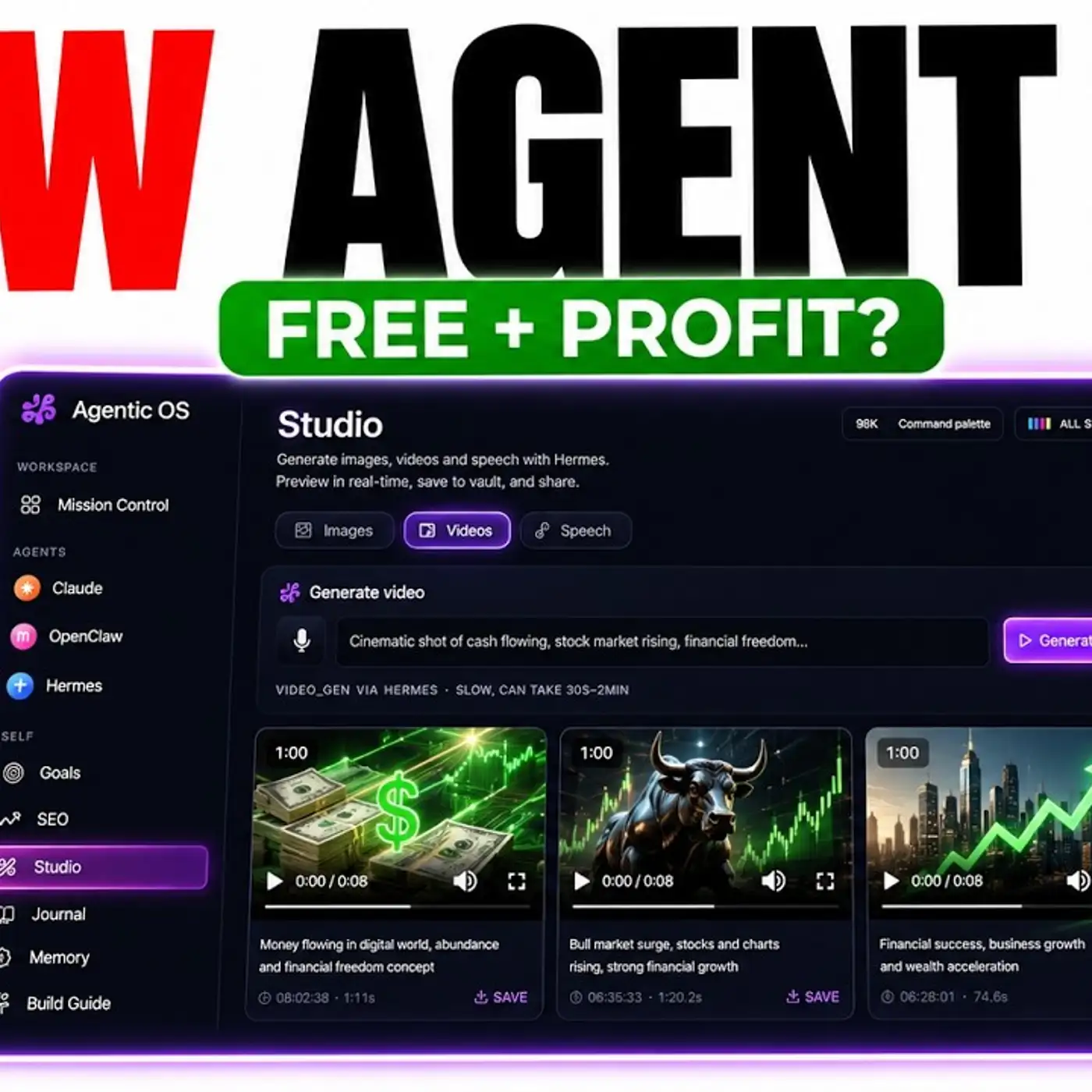
And there's a studio for making stuff. So for example, for making images, for making videos, for making podcasts. If you want a quick image for a post, done right there. If you want a voiceover, it's in there.
If you want to turn your notes into something people actually watch. That's built in too. So let me give you a real example of this. Let's say for example, I want to generate a podcast about AI automation.
Maybe minimaps just came out. I want to create a podcast about that. I could just click on the here, paste in the transcript for the podcast, and then we're good to go. That's basically how it works, right?
So you're not the one doing the busy work anymore. You're just a boss. You hand out jobs and your agents do the work for you. So here's a belief that I want to really break for people.
Some people think, you know, the AI is just a chatbot, that it's something that you just speak back and forth with. The problem is that's the old way. The new way is AI that does the work for you. AI that runs jobs whilst you sleep.
AI that remembers and builds ships for you. We actually have something called UltraCode that can run for hours inside Claude and that's built into the dashboard here. There's also something, and this is a mode that Hermes has. Hermes has it, Codex has it, and you can set a goal, walk away and the agent just keeps working until it's done.
So you can come back later and it's finished and you weren't even at the desk. So think about what that means. Like you set a goal at night, you wake up and it's done. Now, I want to be straight with you.
Does every part of all of this work every single time? No, these are real tools. You know, real tools have rough edges. Some days an agent's awesome, some days you have to nudge an agent.
That's just me being honest. But even with rough edges, having all of it in one place beats the chaos of 10 different tabs every single time. And that's why the agent operating system matters more than any other agent. This is the power of it, right?
So as an example of this, I mean, check out this. It was built with Hermes as well and OpenCore. So agents come and go, new ones launch every month, the better one drops, new models coming, you swap it in. The operating system stays.
It's the thing that holds all of this together. The agents are the workers. The agent OS is the building they work in. Now, let me handle the doubt that I know some of you have, which is I don't have time to set all of this up.
Don't have time to build this and that's fair. But how much time are you losing right now? Re-explaining yourself to AI every day, hunting through tabs, starting over. That's a real time sink and setting this up once saves you that every single day.
Another doubt is like, I'm not technical enough, but we've already covered that. Beginners are doing this. And here's the deeper truth. You don't need to be technical.
That's the whole point of having an agent operating system instead of just trying to manage the agents inside your terminal. Now, last one is, you know, some people say, well, I'll just wait. I'll wait for, for agents to get better, but wait for what, right? Every month, this stuff gets more powerful.
The people building their command center now are the ones who'll be miles ahead in the future. The gap between people run AI agents and people type into a chat box is getting wider fast. Waiting doesn't keep you safe. Waiting puts you behind it.
And here's how I think about it. This is something I've learned. I mean, we've even got like video agents, we've got SEO agents. So two years ago, having one good AI was the edge.
Now everyone has that. The edge today is having a system, a command center, an operating system that makes all your agents work as one. That's where the world is heading. That's what we're working on here.
So, you know, one person running a whole team of agents from one single screen, doing the work of maybe 10 people from the kitchen table. And you don't need to be a coder to get there. You don't need a tech degree. You need the right setup and someone to walk you through it.
So let me give you the simplest way to think about your next step. If you've never touched AI, just one, you know, start with Claude. You can build it into an agent operating system like you've seen today. You can try one thing and just go with that.
And, you know, if you're already deep in this, wiring more agents, build out your command center. Let them run jobs whilst you sleep. Whoever you are on that ladder, the direction is the same. Towards the system and away from chaos.
And the reason this matters isn't the tech. The tech gives you back your time, but really what matters most is the time itself, right? Time with your family. Time is to think instead of grind.
Time to actually run your business instead of drowning in busy work. And that's the real prize here. Not a cooler chap on your life back. So if you want to get your own agent operating system, you know, you could build it yourself, but if you want my system with AgentOS and Claude wired straight in and the exact system I use, come grab it in the AI Profit Boardroom.
You'll get the full agent operating system, the zip file, a step-by-step video tutorial so you don't get stuck and daily updates every time we improve it. You can plug it in your Claude, your Hermes, your OpenCore, all of it into one command center. Plus you get four coaching calls a week to go deep on your setup and 3,000 business owners in their right building there's right now alongside you. Link in the comments description or go to the AIProfitBoardroom.com to get it.
Build your command center and stop starting over every single day.
More episodes